

Top Tips from Debra Chantry-Taylor:
1. Success Is The Most Dangerous Moment In Business
“We’ve just had our best year ever” is one of the most dangerous sentences in business. Businesses rarely get into trouble when things are bad. They get into trouble after things go really well, because success relaxes discipline. Leaders stop asking hard questions, curiosity disappears, and blind spots start to grow.”
2. Stay Curious And Keep Looking Outside The Business
“The first thing to go after success isn’t strategy, it’s curiosity. Leaders start thinking, “We’ve got this nailed,” and while they’re focusing internally, the world around them is changing. You have to keep challenging things, keep interrogating the data, and keep looking externally as well as internally, otherwise decline starts quietly before anyone notices it.”
3. Discipline And Structure Prevent Decline
“Growth without discipline creates drift. Priorities multiply, focus disappears, meetings become surface level, and problems start getting explained instead of solved. Structure and cadence matter. Level 10 meetings, scorecards, and clear accountability help leadership teams stay honest, spot trends early, and keep the business moving forward even after success.”
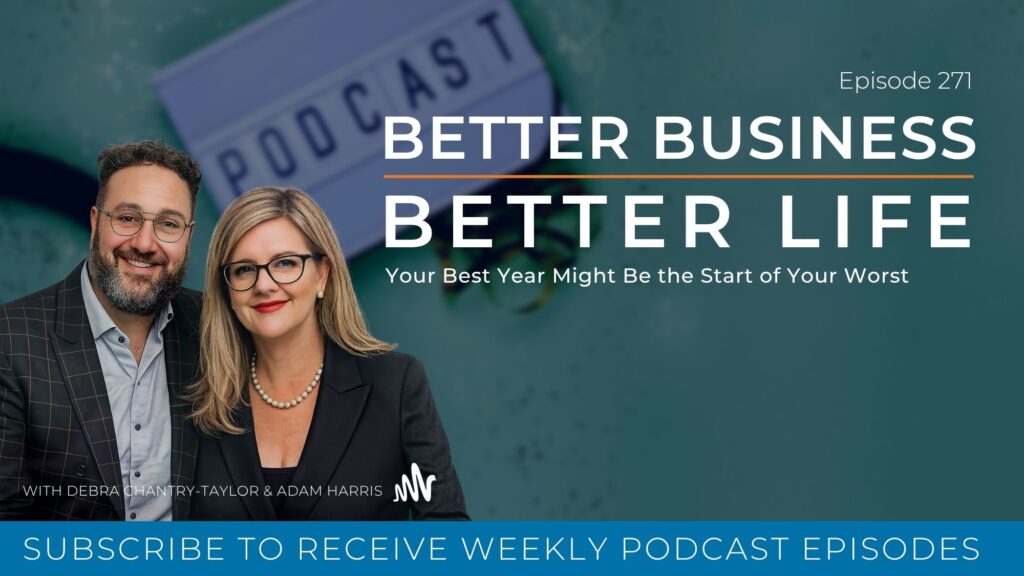
Debra Chantry-Taylor 00:00
We’ve just had our best year ever. It is the most dangerous sentence in business, because in my experience, businesses rarely get into trouble when things are bad, they get into trouble after things go really well. The first thing to go after success isn’t strategy. It should be curiosity, because once curiosity drops, the blind spots really start to grow. We’re not challenging things. I think this is probably one of the biggest things, is that we kind of go we’ve got we kind of go we’ve got this nailed, and while you’re focusing internally externally, things are changing, and so it’s really important that we don’t get caught up in just what’s happening internally, we actually start looking externally as well.
Debra Chantry-Taylor 00:39
Hello and welcome to another episode of Better Business, Better Life. I’m your host, Debra Chantry-Taylor, and I’m passionate about helping you lead your best ever life by creating a better business. I work with owners and their leadership teams in both family businesses and privately owned businesses to help them put in place a set of simple, pragmatic tools that really helped them with growing and scaling their business. And as we’re coming into the end of financial year for our New Zealand and Australian businesses, I thought it’d be really good to cover off a topic that is quite dear to my heart. The title is your best year might be the start of your worst. Or in other words, why success is the most dangerous moment for leadership teams. So what I want to do is start with a sentence that should make every CEO slightly nervous. It is the most dangerous sentence in business. We’ve just had our best year ever. That’s not a bad thing, but it is a dangerous thing, because, in my experience, businesses rarely get into trouble. When things are bad, they get into trouble after things go really well, not immediately, but quietly and gradually. So first of all, let me be really clear. I’m really hoping you have had the best year ever. I that’s what I wish for everybody. I just want you to take caution and make sure that we learn how not to fall into the pit that comes after that. So Jim Collins, you know, one of my favourite authors, spent years studying companies that went from great to irrelevant, and what he found was that it wasn’t stupidity or laziness, it was a pattern of leadership behaviour that slowly shifted after success, and that’s what this episode is all about. So why does success change behaviour. Well, when things are tough, leaders are sharp. They ask better questions, they argue more, they pay attention to detail. They have to do more with less, and so therefore, they have to think quite differently. Whereas success does the opposite. It relaxes discipline. Meetings get shorter, the debate will soften. The data gets skimmed as of really being interrogated. It’s not that anyone decides to lower the standards. It’s just they stop noticing that they have and the results keep looking good, so nobody calls it. That’s how decline starts. So there’s five stages I want to talk about that will just help you to understand why this happens and help you to avoid this pitfall. So stage one is where arrogance comes from. Past wins, but this stage doesn’t look like arrogance. It looks like confidence. We know what we’re doing. We’ve seen this before. This won’t happen to us. Leaders start to listen less, and the questions start to disappear, and dissent feels unnecessary. The first thing to go after success isn’t strategy. It should be curiosity, because once curiosity drops, the blind spots really start to grow. Stage two is chasing growth without discipline. And this is where success gets dangerous, because growth becomes the goal, not the result, more initiatives, more projects, more opportunities. Everything sounds reasonable, nothing is ever finished. So priorities multiply, the focus disappears, and this is where EOS discipline quietly erodes to we get too many priorities, too many rocks. Really unclear. Ownership, no real stop doing lists, just keeping adding things, adding things, things that never get finished. People start working harder, the business gets noisier, but execution slows. Leaders will call it growth, but it’s actually Drift Stage Three, explaining away the problems. So this is the most dangerous stage, because it sounds sensible. Data starts getting explained instead of faced. It’s temporary. It’s the market. It’ll settle next quarter leadership meetings become optimistic instead of honest, and bad news is softened and issues are parked. EOS truth bluntly. If the numbers need a story to make them feel okay, then something is wrong because you cannot solve what you refuse to name. This leads into stage four, searching for a saviour. So now the pressure is really visible. The results are wobbling, that confidence is cracking, and so leaders start to reach for dramatic action. Let’s do a big higher a big restructure, a bold move. These aren’t wrong by default, but they’re wrong when they replace discipline with drama. Most saviour move. Moves fail because they’re trying to fix symptoms, not behaviour, and stage five giving up quietly. This isn’t collapse, it’s erosion, the belief fades. Good people leave execution phrase, the business doesn’t die. It just stops mattering, and that’s the real end. So why this is preventable? Well, here’s the good news, decline is slow, which means it is preventable, but only if your leaders are willing to stay humble after the wins, interrogate data honestly, maintain discipline when it feels unnecessary, and keep your leadership standards high when results are good, your best year is not the problem. Your Best Year unexamined is. So if you want to create a better business, to create a better life, you can only do that if the leadership team stays awake after success. So that’s my brief synopsis of the Jim Collins work and the stages we go through after a great year. And what I asked my chat GPT to do was to give me 10 ad lib questions that I can answer just off the cuff based on my experiences observing several 100 businesses go through this and see what I can come up with. Do not take my answers as gospel. It’s just my observations, but I’ll do my best to answer them honestly and openly. So I haven’t read these yet. Number one, what’s the first discipline you usually see slip after a great year? I actually start seeing it slip more than just after a great year, I start seeing it slip in quarterlies, and that is ignoring the scorecards. The scorecard should be a tool that gives us a finger on the pulse of the business, and we should be really looking at that data. And we should be looking at it every 90 days and saying, Are we still measuring the right things? Are we measuring the things that actually give us the correct outcomes? And if not, we need to actually discuss it. But also, you know, are we actually pushing ourselves to still continue to look for better ways of doing things? So I would say that that’s the data. Is probably the first discipline that actually slips number two, how does confidence quietly turn into entitlement? In leadership teams, entitlements a strong word. I think that what happens is it’s great that we get to celebrate success. We absolutely should. It’s one of my biggest things. I don’t think we do it often enough, but if we’re doing really well, and we are, you know, we’re getting really confident about what we’re doing, we just, we kind of take it as a given, and therefore it does become a little bit like that. This is just the way that it will be. So I’m not sure what’s entitlement is almost like a bit of a laziness in terms of it’s going well, aren’t I doing a great job? Everything’s rosy. And that’s interesting, because the next question is, what does arrogance actually arrogance actually look like in real businesses? Again, I don’t know that it comes across as arrogance as such, but it is just we get this sense of we’re doing really well. We know what we’re doing and we’re therefore, we’re not asking the difficult questions, we’re not challenging things, we’re not looking for what’s going on around us. I think this is probably one of the biggest things, is that we kind of go, we’ve got this nailed, and while you’re focusing internally externally, things are changing. And so it’s really important that we don’t get caught up in just what’s happening internally, we actually start looking externally as well. Number four, where do you most often see data being explained instead of faced? Most often, I think in sales, I see this all the time when I sit through level 10 meetings, is that when we get to sales results, we kind of explain how things are going, rather than actually facing the reality. We see things start to drop, and we kind of go, oh, but it’s the market or Oh, it’s marketing. And there’s always some excuse as to why, what’s going on, where, in actual fact, you need to dig deeper. Was really interesting. In a session the other day, you had a scorecard measurable that was read and off track all the time. And so when we actually kind of delved into it, we wanted to make sure we’re actually measuring the right thing. And it turns out, we’ve kind of lost track of or lost the understanding of why that piece of data was important. And so we actually weren’t measuring the right things, which means that we weren’t we weren’t using it to then make decisions like data should be really about the finger on the pulse, but also a chance to dive deeper and find out what’s really going on. So yeah, Taylor was probably the biggest area. Number five, how do priorities quietly multiply after success? I think it’s because we get, maybe arrogance is the right word. I think we do get a little bit arrogant. Kind of think if we can do this, we can do this, we can do something else. And so we start taking on more and more, and that could be more and more rocks. It could be new new markets, new products, new services. Because we kind of go, if we can do this, we can do anything where, in actual fact, when we lose sight of what our knitting is, so stick to your knitting. Just make sure that you’re really focusing on the things that are important, to make sure that we’re not letting arrogance kind of think, make us think make us think we can do anything and go back to your core focus. Why do you do what you do? And what do you do better than anybody else? Does this really make the boat go faster? Number six, what meeting behaviours change? First, when discipline erodes. I’ve seen this where suddenly the level 10 meetings people start missing. Them, or they are just very quick once overs, rather than really challenging the way that things are. So I think it’s and then yeah, just, just less Yeah, less long meetings, less interrogative meetings, and people feel like it’s okay to miss it or maybe turn up late. That’s the things that I see. Number seven, how can leaders spot stage one or two decline early? I think that it’s just about looking at your data, being honest about your data, being realistic about things, and also just being being very aware that, yes, just because we’ve done well so far, not not, not thinking about what else we could do differently. So making sure that, I suppose leadership team meetings should be about the future of the business, not just business as usual. So make sure that we’re really encouraging open, honest and vulnerable conversations in those leadership team meetings all the time, even when things are going well, to make sure that we’re not missing out on something that perhaps sitting there in the background. Number eight, why does saviour hires so rarely work? I’m not sure if I know the answer to this, but my gut kind of says that we go in there looking for somebody to come in and save the business. It’s usually a sales person. It’s usually the we need a new sales person because our sales have dropped and you put too much pressure on them. Everybody looks to them to make the decisions and to make the changes and to save the company, when in actual fact, it’s the leadership team as a whole that has to work together. So I think you put a lot of pressure on new person coming in to do that, whereas, in actual fact, we should be looking at ourselves as a leadership team and saying, you know, what do we all need to do to actually make this work? Don’t put it on one person. Number nine, what role does structure and cadence play in preventing decline? Level 10, meetings are my favourite because they actually work on structure and cadence. They are about bringing your accountability chart to life. They’re about making sure everybody understands what role they play, and it’s about doing it weekly, which means you’re seeing things. You’re seeing trends. So even though you might be hitting your sales targets, look for those trends. Look for the things that are happening week on week that could give us an indication of what is really going on. And Number 10, what would you say to a CEO who’s just had their best year ever? So first of all, I definitely say congratulations. I mean, I really don’t believe we celebrate success enough. It’s one of my biggest kind of bones of contention around New Zealand and Australian businesses. We are really highly critical, but we don’t actually celebrate success. So I would first of all say congratulations, and then I would say, Please don’t become complacent. This is a great springboard to continue to scale and grow the business, but you’ll only do that by keeping your pedal to the metal in your car, making sure you keep fine tuning it, keep looking for ways to improve it. Keep looking for things that maybe aren’t working as well as they could be. Just don’t take your foot off that pedal. Okay, that was my 10 questions and 10 answers completely off the cuff. Hopefully that is helpful to you. I’ve got a lot of experience seeing these things in action, and I am here to help. So if you’re listening to this episode and thinking, Gosh, I need some help with this, please get in contact with me. My email is debra@businessaction.com.au or debra@businessaction.co.nz I work across Perth, Melbourne and New Zealand, so if you’re in any of those areas, I would love to have a chat to you. But even if you’re not, I genuinely am here to help. I would be happy to help you myself, or put you in contact with somebody who can I want you to create a better life through creating a better business. So thank you for listening, I look forward to hopefully having you come and join us again. Thank you.
=======================================================================================================================================================
Debra Chantry-Taylor
Certified EOS Implementer | Entrepreneurial Leadership & Business Coach | Business Owner
#betterbusinessbetterlife #entrepreneur #leadership #eosimplementer #professionaleosimplementer #entrepreneurialbusinesscoach
Certified EOS Implementer New Zealand
Certified EOS Implementer Australia
Certified EOS Implementer UK
Certified EOS Implementer NZ