

Top Tips from Amanda Barkey:
1. Use The Level 10 Meeting To Transform Your Business
“My favourite EOS tool will always be the Level 10 meeting, and it absolutely changed the game. It does so many things for a business. It keeps the circles connected, it improves communication, team health, and results. It’s the linchpin that holds everything together, and once you get into the rhythm of it, it becomes truly transformative.”
2. Don’t Just Use EOS, Run On EOS Properly
“There’s a big difference between using EOS and actually running on EOS. You can read the book and use the tools, and that will help, but there’s a method and a process behind it that really matters. If I could go back, I would hire an implementer, because it accelerates everything. Otherwise, you can spend years figuring it out yourself when you could get there much faster with the right support.“
3. Build A Business That Runs Without You
“When you implement EOS properly, you’re turning your business into a turnkey operation. You’re putting in the structure, systems, and processes so it doesn’t rely on you anymore. That not only makes the business easier to run day to day, it also increases its value. When it came time to sell, we could hand over a self-sustaining business, and that made a huge difference in the outcome.”
SUMMARY KEYWORDS
EOS tools, level 10 meeting, business communication, team health, franchise businesses, self implementation, integrator role, visionary, core values, family VTO, business sale, entrepreneurial life, nonprofit work, fractional integrators, business growth.
Amanda Barkey 00:00
Most people will choose a life of unhappiness over a life of uncertainty. And entrepreneurs choose a life of uncertainty. Figure out what you want and go get it. There are resources. There are things to help you to get what you want. My favourite EOS tool will always be the level 10 meeting, and it absolutely changed the game. It does so many things for a business. It keeps the circles connected, it improves communication, Team health, results, and so that was just such a game changer for us.
Debra Chantry-Taylor 00:35
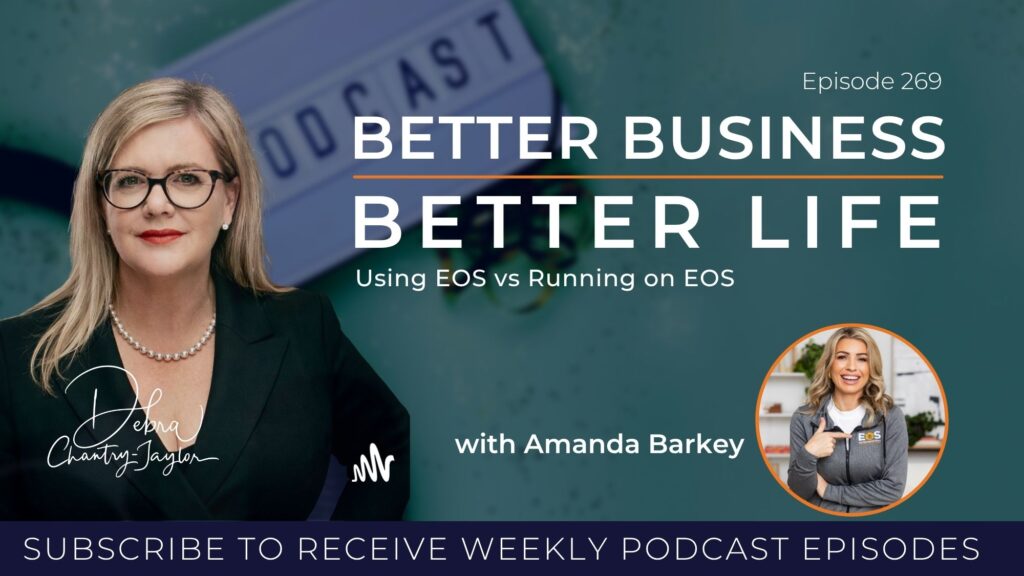
Welcome to another episode of Better Business, Better Life. I’m your host, Debra Chantry-Taylor, and I’m passionate about helping business owners lead a better life by creating a better business. I started this show to actually bring people onto the show and share their experiences in the hope that it will actually resonate with you and perhaps strike a chord give you some tips and tools to actually help you create a better business. And so I invite EOS implementers. People are using EOS in their practice. Anybody who is passionate about EOS or complementary tools that can actually help you lead that better life. My guest today has been on the show before, once she came on with her husband, she talked about their franchise businesses, and she’s also been on and talked a little bit about herself as an EOS implementer, what she was doing now she’s coming back on the show because she has just sold eight of their franchise businesses, which they owned for over 20 years. They self implemented EOS into those franchise businesses, and she truly believes that helped with the sale of those businesses. She uses EOS not only in those businesses, but also in the family. Her husband and herself have got five kids, and they use EOS in that family as well. And today she’s going to share with you the difference between using EOS and actually running on EOS. Amanda Barkey is a certified EOS implementer based out of Hawaii in the US. Welcome back to the show, Amanda, it’s lovely to have you here. Thank you so much. It’s my pleasure. It’s been a little while since we’ve had you on the show. And those who haven’t heard the previous podcast, we did one with your husband, and we talked about your franchise business, and then we did one with you and we talked about EOS. Since I last spoke with you, quite a few things have changed in your life. So you’ve moved to Hawaii, you’ve sold your franchises a whole bunch of stuff. So why don’t you give us a little bit of a back story, going back to the beginning, and then what’s happened more recently for me.
Amanda Barkey 02:24
Sure, I’d love to thank you. So I was born and raised in Canada. I’m a first generation born Canadian. My grandparents were all political refugees. My parents are immigrant. I did not come from an entrepreneurial family. I was bit by an entrepreneurial bug when I met married my husband, I swear he came out of the womb with the business plan. So we’ve been living an entrepreneurial life together for the last two decades, and we’re partners in everything, business, life, love, parenting, everything across the board. And so yeah, we moved down to the states from Canada in 2008 to start our business. We owned a business called soccer shots. It’s a children’s soccer programme for two to eight year old. We thought we were killing it with 63 kids enrolled in our programme in the first season. Fast forward, we serve over 10,000 families, you know, in our franchises in Southern California and in Hawaii combined. And so we’ve been through a lot. It’s been a roller coaster ride, that’s for sure, but we’ve done it all together. And yeah, like you said, we recently sold all of our soccer shots franchises, and so we’re entering a new era of entrepreneurship. But you know, when we first started those businesses, we didn’t know what we didn’t know we were learning from our mistakes, growing by our reputation. We knew there was a better and easier way to run a business. We just couldn’t quite put our finger on it. So that’s when we read traction, and that was a game changer for us. It was our light bulb moment, and we implemented the tools and disciplines in our business. It profoundly changed my life, personally and professionally. Transformed my life, and so I’m a big believer in EOS and what it can do for not just entrepreneurs, but, you know, I have five kids, three businesses, a non profit, and people always ask me, like, how do you do it all? And my answer is, EOS. I’ve EOS my life. And so, yeah, so I, I jumped in with both feet. I became an EOS implementer, and so that’s my full time gig, and it’s my life’s most rewarding and fulfilling work. And so I’m excited to be here with you today to talk about all things business, life, EOS. And yeah, I’m thrilled.
Debra Chantry-Taylor 04:32
Thanks. We’re going to definitely talk a bit about the EOS in your family as well, but I want to talk about the business first. And so we had a quick chat before we came on board, as we always do, and you shared with me that you self implemented EOS into those franchises for a number of years. Can you give us a little bit about how that went for you and what some other challenges were? Yeah, sure, yeah.
Amanda Barkey 04:55
So we bought our franchises, moved down to the states, packed everything in. Back of our well, actually bought, I said, franchises. We bought our first franchise and moved down to the states, and we had everything packed in the back of our car. We had a six month old baby. We were on food stamps. Wick slept on floors. Our kids slept in our closets. I also had four kids in five years in those startup years of our business, and so, you know, we, neither of my husband and I both come from humble beginnings. Neither of us were backed by money. We didn’t have any business loans, grants, funding, nothing. And so we just kept reinvesting in ourselves, grinding, hustling, and yeah, it was just really hard, and we read traction. And you know, we were broke as a joke. And so I told you, before the recording started, like, if I could have created, if I could create a time machine, if I could go back, and if I could have done it differently, I would, in a heartbeat, knowing what I know now, but even if I could go back, like we didn’t have any money. And so, you know, reading traction, you could spend 20 bucks or go to even there are traction books at thrift stores. You can pick them up for a few bucks and and you can implement the tools and disciplines. Nothing’s hidden. It’s all in there for you, right? And so that’s what we did. We’re gritty, resilient, resourceful entrepreneurs, so we just started using the tools and disciplines in the book, and it just absolutely shifted everything for us. It was such a game changer. Those five foundational tools are so powerful, and so we implemented them in our business. We did find a rock star, integrator. She She was with us for a decade, and she really was instrumental in implementing those tools and disciplines. My husband’s the visionary. We own. We owned our businesses together, 5050, but he was the visionary, and we’re both visionary esque, and so, you know, I remember taking the crystallizer assessment years ago to discover and and who we were. And I remember my husband kind of sitting there because he knew he was a visionary, and he really wanted me to be an integrator, and it turns out I wasn’t, and he was really disappointed, but we found someone, and that was really instrumental for us in implementing all this stuff. Because, you know, left to our own devices, it’s like, you know, we get really excited about something, and then the follow through isn’t exactly always there, and so so I think having our implement or our integrator was key. Without having an implementer involved, she was. She really, now that I see things from the other side as an implementer, there’s a lot that I would do differently, but she really, she did a really solid effort and did a solid for us, helping us implement everything.
Debra Chantry-Taylor 07:43
She obviously fully embraced it. It’s kind of interesting though, because I was thinking about this as we were talking earlier, you expect that when you buy a franchise, that it’s all kind of laid out for you. And so I would have thought that, you know, buying a franchise, it should have been as simple as just jumping in, following the franchise processes and everything should just grow the way that it should, but that’s obviously not the case. I mean, not that you didn’t. I mean, you obviously turned it into an amazing business, but there were some challenges in the beginning, and there obviously was something that made you think something was missing to even look at attraction books. So What? What? What happened? Why? Why was just the franchise model not enough?
Amanda Barkey 08:20
Yeah, well, so that’s not our story. That’s probably a lot of people’s stories. When they buy a franchise, right? It’s turnkey, and that’s a really cool thing about buying a franchise and the franchise model. You know, if you want to be an entrepreneur, and you’re not necessarily like an inventor of something, or you’re, you’re, you know your mind doesn’t work that way, but you want to own a business. Owning a franchise is a really great option. But for us, like, we bought into the franchise model in the early, early, early stages. So we were like old doggies in the franchise system. And so when you buy a soccer shots today, you are buying something totally different than what we bought. And like, we paid a very different price for that as well, right? And so, but like, what we bought was, really, we bought it on a handshake deal. And, like, it was like, you know, we saw a few training videos, and it was just kind of like, okay, go do your thing. Like, there was no, you know, there’s no handbook, there’s no we. Nothing was developed. And so now when you buy a soccer shot, it’s a lot like what you were describing. And so they’ve done a lot of work, and we and that’s been a really special thing for us to be a part of, because we bought in so early on in the franchise development, we’ve been a part of developing what you get today. And so that’s been fulfilling for us as entrepreneurs to be a part of that in a regard. But yeah, so for us, like, there just wasn’t a lot of support back in the day, we were in the early stages of being a franchise, and franchisees, like, just really, like, all pulling together and kind of, like. Were figuring things out as we went along together. And so we actually were handed a traction book by someone who works for soccer shots franchising. So there was, you know, a mastermind of the top 10 or top 20 franchises, and we had, like a book club. And so then traction was one of the books that we read. And so I think about two thirds of the soccer shots franchises have used EOS in some regard. Soccer shots franchising runs on EOS. They’ve, I actually connected them with an implementer a handful of years ago, and they worked with Justin mink, and so he was their implementer. And so they’ve done it the right way. And so, you know, just like As goes the leadership team, so goes the rest of the organisation. It works like that in a franchise. And so, yeah, a lot of stuff is handed down to the franchisees from franchising, and it’s wonderful when they run on Eos, because then it kind of all trickles down, right? Wasn’t like that in the beginning, but it did. It kind of went like that over time, but we all kind of built this together.
Debra Chantry-Taylor 11:03
And I think I mean thinking about that, the EOS is, you know, it’s your daily business operating system, whereas the franchise is the bigger sort of framework around what it is that you’re offering. And we always say that EOS is there for businesses that are already, already know what they’re selling, who they’re selling to, already have a business. And so therefore, if you think the franchise provides all that, what you’re doing, who you’re serving, where you’re going, I guess EOS is the internal operating system to keep all your people, yeah.
Amanda Barkey 11:31
I mean, yeah, we always see how it like, harmonises and orchestrates all the moving parts, right? And so every business, whether you own a franchise or you’re a business, you know, stand alone. It’s just going to harmonise and orchestrate all those moving parts, and especially when there are people in your business, right, like you, as you can probably attest, like most of the time, I would say 80% of the time, the issues on the issues list, the root is people. They’re usually, you know, there’s there are some sort of people issues when you dig down deep and so, so doesn’t really matter, like, when, if the framework is there, the the skeleton is there from the franchise, like within the business, within your own particular franchise, you’re still going to have issues. You’re still going to have, you know, daily operating things that you need to work through. And so that’s where EOS comes in. And it just harmonises and orchestrates all of that.
Debra Chantry-Taylor 12:26
It’s interesting. One of the things you said, and you said it before we came on the podcast, which is why I wrote it down, but you said it again just a moment ago as well. It’s like, if I could build a time machine, I could go back, I would. And this was around, you know, the self implementing versus getting an implementer on board. So now that you’ve been on the other side, and you’re part of the gang, the cult, whatever you want to call it, of Eos, implementers, who are out there infiltrating the world, what do you what do you see as what you know? What would you have done differently and why?
Amanda Barkey 12:55
Yeah, you know, I think hire an implementer that’s as simple as it can be. And there are so many reasons, but the EOS proven process is such a beautiful thing. It’s the best and right way to to implement EOS into your business. You know, you can read the book, you can use the tools, but I think there’s a big difference between using EOS and running on EOS. So we were using EOS in our business, and that was great. It changed a lot of things for us. But now that I’m on the other side, I have this unique perspective, perspective, right? And so I’m on the other side of the orange curtain, and I see, I’m seeing how the sausage is made, and like, there’s a method to the madness. There’s a psychology behind all of it, and I get it now, and once that clicked for me and I, and I got the reps in doing this work with other teams in other businesses, I was like, Oh my gosh. Like, this is such a brilliant thing, and not just in of itself, with the tools and the disciplines and how it improves your business, but the process in which we implement it in it’s there’s so much brilliance there, and it’s really not, it shouldn’t be on you as a business owner to try to figure that out and wrap your mind around. I mean, look, I’ve been doing it now for a handful of years, full time, all day, every day. This is what I’m obsessed with, and what I do day in and day out, and it’s clicking for me, right? But so for a business owner, like your job is to do your business and do what you’re genetically encoded to do, you shouldn’t have to also do what I’m genetically encoded to do, right? There are people out there that can help you with that. I think I told you earlier, when we were chatting like I was talking to my husband the other day about our self implementation experience, and he joked, yeah, we crammed two years of learning into five years, right? Because it really took us, like it’s the EOS proven process. On average, our clients stay on with us for about two years, sometimes shorter, sometimes longer, sometimes they stay on with us forever. But I. It took us a good five years to really get all of the tools and disciplines implemented into our business. And it’s just, you know, you can save so much time, resources, energy, headaches, all of that, by using an implementer. So if I could go back, I would, and
Debra Chantry-Taylor 15:19
I think also you mentioned having an integrator is really key as well. And so when you get an so when you get an implementer and an integrator, I mean that really is we talk about rocket fuel with a visual integrated but it’s like rocket fuel on steroids, because then you’ve actually got somebody who is there helping you with the tools, helping you to understand the proven process, and then somebody who’s championing it day in, day out in the business, which is often what is missing in a business?
Amanda Barkey 15:41
Yeah, the integrator is the glue that holds everything together, right? They integrate the way that the leadership team, including the visionary, who’s usually owner, founder, they’re a little, you know, zany out there, distracted by every shiny object. And so they’re the glue that holds all that together and makes sure that they’re driving discipline and accountability in a business. And so, yeah, I’ve, I’ve worked with a lot of teams now, over the hat, you know, the course of the last handful of years that I’ve been doing this full time, and I’ve seen a lot of different configurations of teams, and when you have a visionary trapped in an integrator seat, you’re just going to have a lot of 90 day spikes, and then chaos ensues. And so it’s so rewarding and thrilling for me when a visionary finds their integrator and and, you know, we’re kind of like the three legs to the stool when we’re in that implementation phase, and we go into that execution phase, when there’s a really strong visionary, a really strong integrator and then a really strong implementer, we’re all working together to make sure that we’re getting this all, like, going, it’s really exciting. It’s really fun. And we can almost, like, supercharge this when, so when one of those legs of the stool is missing, it still works. You know, the stool is a little wobbly, but, but it’s just, it’s really phenomenal when, when everybody is in the right see, and we can all do this like as a team and and really expedite the process and make, you know, and create rocket fuel.
Debra Chantry-Taylor 17:07
It is so true. I actually, I don’t know if you know, but we have another business on the side, which is called Sherwood foundry, which provides fractional integrators into EOS businesses versus rank on EOS. And, you know, even just putting a fractional integrator in, and if you get the right one, which is our job is to that matchmaking and make sure you’ve got the right integrator for the visionary that’s in that business. You know, we put our fractional integrators in it, and it’s amazing. Within a very, very short period of time, we can see the massive impact they actually have, mostly around that visionary relationship. And of course, yes, they’re, they’re the Orca, they’re holding every together. They’re the conductor that kind of keeps the orchestra playing the right tune. But it’s really that relationship with the visionary. I think that when you do get that right, it is just, it’s phenomenal. You can you get to see results pretty quickly, which I love.
Amanda Barkey 17:51
It’s such a relief for visionaries to get an integrator right. When they’re like, oh, like, I remember, you know, I talked to a visionary one time, and they were like, I always thought that I was a bad business owner because, you know, I never paid my taxes on time, or I never, you know, I didn’t pull permits on time, right? Like, all of these things that, like a visionary is not genetically encoded to do. And then once they figured out, like, oh, the like, the big ideas coming to every meeting with 30 new ideas, staying at 30,000 feet like you know, all of those things are what visionaries genetically encoded to do, and when they sort of are able to, when they’re released of that, of the burden of having to do all those things that they’re not genetically encoded to you, and they Have someone else, a counterpart, that are bolstering them up. It’s really cool to see how much freedom it gives to a person, to an entrepreneur, and I’ve seen that happen countless times. And it’s just it’s really fun for me, especially when I’m working with established businesses, when they’ve been in business for 1015, 20 years, and then they figure this out. And they’re like, oh, oh, I just, you know, I’m Walt Disney, and I just need Roy. I need Roy to help me to figure this out, bring all my dreams down to the ground and create magic, right? And so it’s really fun. It’s great when, when a visionary gets an integrator, and it’s just it gives them that ultimate freedom and that relief. And I’m such a big fan of fractional integrators, my integrator, so we found her. She before we started, well, we read traction, we’re like, we got to do this. And we literally ripped off the description of an integrator from rocket fuel. We put it in, I think we put it on Craigslist, and we found we had, like, 100 applicants. And then we found Nancy, and so she was our full time integrator. We implemented, we all self implemented together, and then we’re running on Eos, and then covid hits. And the business that I owned with my husband, it’s soccer shots. It’s a children’s soccer programme for two to eight year olds. We run mostly out of preschools, daycares, childcare centres. So when schools shut down, soccer shots went away. And so we did 2% of our gross revenue in the two quarters following the lockdowns of the previous year, same quarters. And so we shrunk by 90% like soccer shots was gone. It went away overnight. Devastated our business. And so, you know, my husband, Nancy, our integrator and myself, we, the three of us, we, like, had to sit down and really figure out what’s plan, B, C, D, E, F, right? Like, what are we going to do? What we didn’t know there are so many what ifs at that time. And so we helped her actually create her own fractional integrator business. We were like, Look, you, we’re, you’re going to be the last salary we cut like, but there’s going to probably be a point where we can’t afford you. And so what can we do? And so we helped her create her own fractional practice. And so then, coming out of covid, she was our fractional integrator. And then she actually was a fractional integrator for a handful of soccer shots businesses, and then she branched out to into other industries. And then, you know, it was such a great thing that she just kept doing that, and she actually made more money, and she was able to spend more time with her son, doing it fractionally, which was such a cool thing to be a part of helping her figure out. And now she’s a fractional integrator. She actually works for Catalyst integrators. And so, yeah, yeah. And so I love, I think that a fractional integrator can really serve a business well for a time. They’re kind of like a band aid, right? And then, no, they’re, they serve the business for what it needs. And and then hopefully, you know, you can find that they or they can help you find that and train and help you train that new person.
Debra Chantry-Taylor 21:42
Like I always say that with our fractional integrators, we don’t want them to be there forever, much like an EOS implementer, we’re there to kind of help you until you are in a position where you can actually hand it over. So with our fractional integrators, they go in there, they can hit the ground running, which is, you know what? That’s the beauty of somebody who’s really experienced in this, but then they can help them find the integrator from within or from external, and then also train them, so you’re actually giving them the complete solution to then manage it themselves going forward. And we never want them to be there forever, right? Wonderful. I love that, and I think it’s interesting, because people say fractional integrators, how can they possibly they don’t know the business and and they haven’t got the knowledge, but it’s like they don’t actually need it. A really, really good integrator will come in and will know enough Their role is to really integrate EOS into the business and to keep all those parts together and moving together. And so they don’t need to be an expert in your field. They just need to be really, really good at what they do. And I think when they’re working with multiple clients, I think it’s a benefit, because they actually have other experiences they can bring into your business as well.
Amanda Barkey 22:44
Yeah, I think it’s actually better if they don’t know your business or your industry, because you know terms and things like that. You can pick that up pretty quick, but they can see things in a whole new way, right? And they’re there to help you, to implement tools and to, you know, to lead and manage people well and so like so my integrator, Nancy, who, what she was my full time, slash, then she went fractional integrator for a decade. I don’t think she’s ever kicked a soccer ball. I don’t think she’s ever watched a full soccer game. Like she’s not a soccer person, but she was a phenomenal integrator, because she had a big heart for people. And she was, you know, we kind of like lovingly referred to her as a velvet hammer, right? And so she was, you know, she was the ultimate accountability, discipline lady. She really drove that in our business with so much grace and so much like such a big heart. We employed. Most of our employees were our soccer coaches. Were 18 to 24 year olds. And so, you know, there were countless times where she was grading their papers and they were coming to her with, like, you know, a for dating advice or whatever she they called her mama Nancy. And so, yeah, when you can find someone like, who leads and manages people well. They don’t need to know your industry or be you know, be savvy in your in your specific business. They’re just they have a really specific skill set, and they’re really genetically encoded to do that job well. And so when you can find them, man, it’s it’s really magical.
Debra Chantry-Taylor 24:19
Your husband don’t know he was desperate for you to be the integrator, and obviously that was never going to happen. How would, how would he describe that relationship with Nancy? Like, what did it do for him as a visionary? Yeah, oh my gosh.
Amanda Barkey 24:31
Like, Well, like I said earlier, relief. I think that’s how we would probably describe it. I mean, I can’t, I don’t want to put words in his mouth, but for him, it really allowed him to elevate to his unique ability to be able to do the things that he’s genetically encoded to do without guilt, right? Because he knew the permits were getting pulled and the taxes were getting paid on time, and there was someone there to pick up the pieces, right? Because a visionary is kind of like a tornado, right? Like they. Or, like, I’ve actually heard like, how they’re kind of like a seagull. They come and swoop in and, you know, and shit on everything. And then everybody’s like, what, what are we supposed to do with this, right? Or, you know, or similarly, like a tornado, you have to pick up all the pieces and, and it’s great because they come in and they inject energy. And like, you know, there’s all these, like, they think of things and see things in a way that you don’t but, but that integrator is really integral. And for for my husband, I know, like I observed, those two really developed this relationship over time. It It strengthened over the course of time to the point where they could, well, for sure, Nancy could almost read his mind, like they were really, like it was, like they were telepathic and like she was truly his ideas filter so and she did it in such a graceful way, like I said earlier, like he would come to a meeting, say a same page meeting, or A level 10 meeting with all these new ideas, and she would do a really good job at listening to him, making him feel seen and heard and valued, and then saying, you know, like, these are all really great ideas. We’re going to go with this one. We’re going to put these other things on the long term issues list so they’re not going anywhere. Don’t worry. But we’re gonna go with this one. This is the one for this quarter, and then they would go for that one. And guess what? By the next quarter, when the other quarter rolled around, and we looked at those other great ideas, he didn’t even remember them or care about them anymore, and so that was really fun to watch someone sort of like, I don’t know mind meld. Yeah, so that that’s a really cool thing about how you know when a when that dynamic Duo’s relationship evolves over time, they’re able to do that.
Debra Chantry-Taylor 26:53
And I don’t know if you, I’m sure you’ve seen this as well with your clients, but I’ve seen a lot with my clients. Is that in the beginning, when the visionary does find the integrator and sort of, let’s go and lets them get on with they feel a little bit lost because they, they haven’t, you know, they’ve suddenly got this, this time frame that they met, perhaps haven’t had, and they, they don’t feel like they’re quite as valuable anymore. But then once they’ve had a little bit of time to get used to it, it is, they get back to that stuff that you said they’re genetically encoded to do, which sometimes is that problem solving stuff, we have when the whole business is stuck and nobody knows how to kind of move from that, they come in and they just had this ability. And I’m a visionary too, so I do this myself, but, you know, come in and you can see it from a completely different perspective, and they can just join the dots and suddenly, you know, break through that stuckness and really push the business forward. So it’s such a joy to watch when they’re able to get back to that, the big relationships, the big ideas, the big problem solving, because then you start to see the business really break through that ceiling and move on. Yeah? So I think I’m sure you’ve seen that with your clients as well.
Amanda Barkey 27:51
Yeah, yeah, I had a client and they were in that really, that flow state, right? That that where they were elevated into that, into that place where they were able to really, like, think about the business in a whole new way, and they came up with an industry disrupting idea. That’s what he called it, too. He’s like, I have an industry disrupting idea, and I don’t think that he would have done that if he was stuck in the day to day, you know, like doing all the integrator stuff. And so when you can see that happen, and people are able to, you know, elevate to that place, it’s really, really rewarding.
Debra Chantry-Taylor 28:33
Okay, so I’m going to ask you one more question about sort of the soccer shots franchises. So you, obviously, you went from one right in the beginning. You implemented EOS. You had eight of them by the time that you were ready to move on, and so you’ve sold them just recently. Congratulations. Do you think that EOS changed the sale price of those businesses? And if so, why?
Amanda Barkey 28:53
Absolutely without a doubt, I know you know when we we thought a lot over the I mean, we’ve owned these businesses for almost 20 years, right? And so we’ve thought a lot and talked a lot about how life might go. We have five kids. Are we like, building a legacy business? Are we going to hand it off to them one day? Are they going to work in the business? Are we going to sell it to them one day? What will this look like? And you never really know, right? And so we actually, so it’s really the way that we’re selling our businesses is really cool. About 90% of the time a soccer shots franchise will sell within the franchise community. There was an opportunity when we first put our businesses up for sale last year where we were thinking we might sell it to someone outside of the soccer shots community, it fell through. Didn’t happen, and so it is turning out the way that people said that it would. And we’re actually selling our we separated the businesses, so we own franchises in Southern California and franchises in Hawaii, and so we’re selling the franchises in Hawaii. To some former employees who used to work for the old owner of soccer shots Hawaii that we bought soccer shots from. And so that’s really cool. They’re they they always wanted to buy it. They weren’t in the position to buy it from the previous owner when we bought it from him. And so now they’re coming in and they’re buying it. And so it’s great, because we know, you know, Hawaii is a different culture. It’s a different place. It’s a whole different animal than than anywhere on the mainland. And so they, you know, that coached in these schools that they’re coming in and working with, and they’ve been to this place, they understand the culture and the people. And so that was really important to us. And then in our soccer shot business in Southern California, we’re actually selling it to two of our previous employees. My kids are all teenagers now, so they haven’t been soccer shots age for a long time, but these people who are buying our soccer shots business in Southern California actually coached my kids when they were toddlers, and so it’s they it feels like they’re my kids, like I feel like I feel like I’m selling my business to my children. And so that’s really special for us to be handing over our businesses in a way that we kind of thought we always would. And then we, you know, like, going back to your original question, we implemented EOS in our business to run a better business and live a better life, not really thinking about the end, right, like but when you’re implementing something like this into your business, you you are doing yourself such a service. And I can speak now from experience. When you’re when you’re selling your business, the valuation of your business goes up because you’re putting these tools and disciplines in your business, and whether you’re a franchise or not, you’re turning your business into a turnkey business, and we’re able to now sort of just like hand a business over on a silver platter to these people. And it’s a, it’s a it’s a joy for us to hand a business over that it doesn’t need us. It doesn’t, you know, all of the processes, all of the, you know, the structure, the systems, all of it’s in place. It’s a self running thing. And so it’s, it’s fun to hand that over. There’s no headaches, right? And so it’s just, it’s been a joy to be able to hand over a business that’s just a self sustaining machine and and, yeah, we’ve been able to get more for the businesses than we ever dreamed or imagined, you know. So we’re walking away very happy.
Debra Chantry-Taylor 32:35
That sounds like perfect scenario. So you’ve got people who can walk in, could take it over. I think that’s the whole point of putting EOS in there, right? It’s to make a business saleable, not because you want to sell it, but it should. If it’s saleable and scalable, it means it’s not reliant on you and you. It sounds like you’ve got that’s the point where it’s going to be a perfect thing to hand over on a place to somebody else. Okay, so it’s what, what is it like for yourself and your husband as two visionaries who are kind of letting go of this? I know that you said you obviously really engrossed in the Eos stuff. Now, what about your Humby? What is he? What’s he going to be doing next?
Amanda Barkey 33:04
Yeah, well, no surprise, he’s already started his next business. So I can’t talk too much about it. I’d have to make you and your listeners sign an NDA, and I don’t, I, I’m not possible. But yeah, he’s created a solution to a problem that we’ve been facing in our business, in our industry, for years and years. And so he’s calling this his $100 million business. And so he’s really excited about it, and really believes in it. And you know, it’s interesting, like we, we always been entrepreneurs. We’ve always lived an entrepreneurial life and walk, you know when, when we when we walked into this and walking into this business, like in our late 20s, early 30s, we were very different people, very different entrepreneurs, than we are today. And you know now I’m in my mid 40s, he’s in his late 40s, and we’re coming into this whole new era of entrepreneurship. And so, yeah, so he’s starting a new business in a new industry, and he’s writing a book, and he’s we’re taking turns. He’s writing his book. I’ll write mine next, but I’m just I’m coaching, teaching, facilitating EOS full time, and I’m working with people I love doing what I love, making a huge impact. We also have our own nonprofit. So we used our for profit business to start our own nonprofit. Back in 2012 when we didn’t have anything, we just started giving away soccer balls, soccer kits and equipment, and going to third world countries and teaching people in underdeveloped areas how to basically do what we do in their area. And so we were doing these one off soccer donation projects for years, and then we found ourselves in Cameroon. And so in West Africa, we have, now, I have a school for children in a remote conflict zone. So there are three. 100 children who go to my school currently. And we have a moto taxi company that provides the salaries for the teachers at the school. It’s also an underground tax ambulance service for you know, because there’s a civil war happening there right now. And we have a prison ministry and an agriculture school and a pharmacy. And so we’re digging wells. We’re doing all kinds of stuff over there. So we’re using all of our for profit stuff to fund that. And that’s where, you know, that’s our passion project. That’s where our hearts are. And so, yeah, we’re just going to keep doing more of that and moving in that direction.
Debra Chantry-Taylor 35:39
Well, that’s beautiful. Now I’m gonna and honestly, I’d truly mean that. I mean know that the things that you’re doing you really are making a huge difference in the world. So I learned that you mentioned that you also use EOS in your family. I’m curious. So I mean people who are people who are business owners who’ve heard of Eos. Now, we’ve got these five foundational tools that we use in the business, along with a whole bunch of other tools that are available as well through EOS. But tell me a bit about EOS for the family.
Amanda Barkey 36:03
Yeah. Well, I we try. Okay. So my kids today are 1213, 1517, and 19. So next year I will have 25 days where I have five teenagers. So you can start praying for me. Now we’re outnumbered. And so, yeah, so it’s just, it’s an interesting, you know, song and dance trying to get teenagers to do anything, but we really believe in these tools and disciplines. And so we have a family VTO. We’ve created a personal VTO. Some of the sections are different. You know, we don’t have a marketing strategy for our family, but we have family core values, a family core focus, a 10 year target, bucket list, adventures and, you know, so just getting us on the same page, rowing in the same direction, all aligned with where we’re going and how we’re going to get there as a family, and staying true to our values, that’s been one of the real key things, you know, like one of our values, for instance, is we own it. And so when there’s conflict between two kids, you know, we will sit them down. And that’s part of the conversation. Like, you know, one of our core values is we own it. So what can you own from this, right? Even if it’s 5% What’s your 5% and so working the core values into like, how we live and breathe and operate as a family, has been really great for our family. Super beneficial. And then, you know, we use, like, the level 10 meeting structure. We’ve used the score card, you know, for taking in the trash cans and stuff like that, like just getting stuff done, like keeping a pulse on our family. And so, yeah, the core, the core values, I think, has been the most instrumental in our family. I would, I would say, for any family listening, or if there’s anyone who’s listening that’s like, yeah, I want to implement these types of tools into my family. Start there. So do a core values exercise with your family, and really get get to the heart of what it truly means to be a part of your family, your unique family and and then live and breathe them. But, yeah, it’s just all about getting us on the same page with where we’re going and how we’re going to get there.
Debra Chantry-Taylor 38:09
And I think the beauty of those core values is it takes a lot of the emotion out of these, yes, well, the situations that arise, and we see it in businesses, when we’re using the people analyzer and we’re talking about, we’re not being I just think you’re this. It’s actually, this is what I call value. Is this is what we will do, what we won’t do. This is the behaviour I’m seeing from you, and so this is how I’m feeling about that. So it’s not actually getting into the emotional side of it. I think that works in the family too, right? If you’ve got very real clarity around who you are and how you operate, then it’s not becoming personal.
Amanda Barkey 38:40
It’s about but this is what we all agree to, that’s right? Yeah, it creates context. It gives you context, and then it also helps you to fill, facilitate, clear and effective communication around it, right? And so, yeah, it’s just, it’s it’s really good stuff, and it translates right, like I use EOS tools in my for profit businesses, in my nonprofit, in my family, and so they just work. They’re simple tools. We you know, like we say, they’ve been around for 100 years, they’re going to be around for 1000 more. So we’re just, we really embrace them. Yeah.
Debra Chantry-Taylor 39:10
Do you have a favourite EOS tool?
Amanda Barkey 39:12
You know, I think you asked me this last time, and I was, I was thinking about that more. I was getting ready, you know, I think my favourite EOS tool will always be the level 10 meeting. That’s the tool. That’s the first tool that we implemented as self implementers into our soccer shots business, and it absolutely changed the game. It just, it does so many things for a business. It keeps the circles connected, it improves communication, Team health results, and so that was just such a game changer for us way back in the day. And I still see it be so transformative for for businesses whenever, you know, when I’m in the proven process with a new client, and we’re in those first three days, right? We’re having focus day where we learn that level 10 meeting and the you know. All five foundational tools, and then over the course of the next about 60 days, we’re coming together, and we’re working out the kinks and bugs, and we’re getting clear on their vision. When, whenever I come back with them and I ask them, you know, what’s working? What’s not working, the level 10 meeting is always like top of the list and and I’m not ever surprised. It really is the linchpin that holds EOS together. And so I think for me, that will always be my favourite tool. And so, yeah, I think that’s, I think I said that last time. I’m not sure I’ll have to re Listen, but I wouldn’t doubt that I said it. I really love that level 10. And then, like you mentioned, the people analyzer, I’m such a big fan of the core values and and having that tool, that people analyzer, is such a simple tool that really helps you to assess whether or not people fit your culture like a glove. And that’s such an important thing. You know, like having the right people in the right seats, you can’t you can’t execute on a great vision without great people. And so getting to work, getting 100% of the right people in the right seats is so imperative, and so that people analyzer really helps. And you know what I I’m gonna give you, I’m gonna do three. Sorry. I don’t know if there’s any rules, but I’m sure I’m breaking them.
Debra Chantry-Taylor 41:15
There’s a vision. There’s a visionary answer for you. It’s like me one thing.
Amanda Barkey 41:19
So I bet no one has ever said this to you before, but compartmentalization. So there’s a tool. It’s in the very back of the leadership team manual, and it shows you where everything goes in your business. There’s a there’s a compartment for everything. And I have a client that I recently worked with, and I’m telling you, Debra, I pulled that tool out. I think it was in. It’s either vision building day one or two. I can’t recall right now, but I pulled it out. I said, Okay, turn to the it was at the end of the day. I just kind of said it like I always say, turn to the backyard leadership team manual. We’re going to take a look at this tool real quick, you know, before we wrap up. And she started crying, and she just bald. And I was like, What did I do? What’s wrong? And she goes, there’s just somewhere for everything to go. She’s like, I’m so relieved. I’ve never felt like this before. And so, yeah, that’s become one of my new favourite tools. It’s just, it’s really cool, like, and I guess it’s the curse of knowledge, right? Like, I’ve been doing this for so long I know that there’s somewhere for everything to go, but seeing it through her eyes and seeing just that like feeling that sense of relief when she realised there’s somewhere for everything to go, it was really powerful.
Debra Chantry-Taylor 42:33
I love it. I love it. I must admit, I do use the compartmentalising video a fair bit, but I haven’t actually looked at the tool for a while. So again, it’s challenging. We’re doing this for six and a bit years now, and and we use this all the time that you just get used to things that be because it’s what you know, but you forget that there are these great tools that can help either getting what you want to talk See, I love that as a tool for really getting people to think about what they need. But if we just quickly cover off those three those three tools, the level 10 meetings, yes, fantastic framework can be used. This is what I found really fascinating in my six and a half years. It can be used in any business, at any level, in any department, right the way down to, you know, people who are on the shop floor sorting out metal in a metal recycling place, all the way up to people who are in the the office doing the stuff. And I suppose it is one of those tools where it’s a bit clunky at first for most people, and they struggle with it, but once you get into the rhythm of it, it is a game changer, right?
Amanda Barkey 43:24
Absolutely, yeah, just having access to that issues list. Have being able to get all that stuff out of your head somewhere onto a list. There’s therapy in that, and then being taught how to prioritise your issues and solve them at the root, yeah, even people on the shop floor, it is, like you said, it just, it’s, it’s a game changer for people in any, you know, any part of the business, all the way from, you know, the CEO, down to the janitor. So I just, yeah, it’s such a powerful tool. And it’s really, it’s, it’s a, it’s a game changer. And especially like when you start migrating it down throughout the business and the people analyse.
Debra Chantry-Taylor 44:00
I mean, as I said, we both said this. It takes the emotion out of things. It gives you a chance to objectively look at something and then use it for a conversation. Because I always say it’s not about pointing fingers or saying, you know, you do this. It’s actually about, this is what we’ve agreed how we’re going to operate. This is what we’re seeing. And then there’s a chance to have a conversation about, how do we actually help you, to either get back up to being, you know, a plus on that people analyzer, or if you’ve got issues around GWC, what can we do to actually help you? It’s a tool that’s really designed to help leaders, help grow their people, and sometimes let people go because, and that’s not a bad thing, you know. I just, I laugh and joke in my sessions, I always sort of say that, you know, you’ve got to be really open and honest in these sessions. Nobody’s ever been fired for anything they’ve said in these meetings, but we do have people leave, and I think I’ve lost four or five people this year from client sessions, and that’s okay. I think sometimes we get upset by that, but if somebody isn’t the right person, and they’re not. In the right seat. It’s not a bad thing to let them go.
Amanda Barkey 45:03
No, exactly, and it’s really powerful, especially I’ve seen when I’m in the session room and someone on the leadership team is like, hey, we have a people issue, and it might be me, you know, like, I might not be the right person in the right seat. And I’ve seen people be really brave and put themselves up on the issues list, and we put them through the people analyzer and figured that out in the session room. And it’s hard, right? We have to get comfortable with being uncomfortable, but it’s really powerful. And you know, there are so many core values out there, good core values, right? Like but if, if so, if a company has three to seven, say, five, core values, and those aren’t your core values. You’re not going to like working there, right? And so the core values are really powerful, even from the you know, we hire, fire, recognise, review and reward people, right? From the hiring part, right? Like you almost want to use your core values to repel people who are not a right fit, because, like Gino says, your company should reek of your core values. And so you know, if you’re not a core value set, that doesn’t mean you’re a bad person. You might just align with another company’s core values, and you’re going to be way more happy working over there than you will be here. So like, let’s all go live our best lives, right? Like, I don’t want to waste time. We have this one wild and precious life. Like, so using your core values to almost anti sell people from working at your organisation is really powerful. But yeah, and I think having a really good, solid core value speech where you define what each of those core values really means in a company, because, you know, like, integrity could mean something different in this company than it does over here. And so really, having those core values defined and being able to articulate it, and having everyone in the organisation be able to articulate it, really, you know, that’s where it’s like, when you know your why, when you know like what, what you’re, who you are, and why you do what you do, like it just like trumps the what, right, like the what is easy once you have all that stuff figured out. So, yeah, cool.
Debra Chantry-Taylor 47:04
And then, of course, the complementalization, which is, yeah, just everything has a place in Eos, which what I love. Oh, my goodness, it has been such I could talk to you all day long. It’s always the same as it two EOS implementers in a room together. Gosh, we could talk about this stuff all along. But I guess the reason why, I mean, the reason I’m so passionate about, and I see it from you as well, is just love to seeing the difference it makes. You know, we had a conversation just a couple of days ago in a client session where it was actually the owner that put their hand up about whether or not they were in the right person in the right seat. And you know that conversation is really, really hard to have for everybody involved, because, you know, nobody wants to challenge the owner and what the owner is doing. But by having the conversation, having it in that group environment, every single person there took something from that and learned something from it, which, which was great, and we came up with a solution. So, you know, it was, it was a good outcome.
47:55
That’s beautiful, that is a leader worth following. That’s for sure.
Debra Chantry-Taylor 47:57
Yeah, absolutely, yeah. So yes, Eos, it definitely, it’s, you know, it’s, it makes a huge difference. It is simple. It’s not necessarily easy. I guess if you had to give some parting words, because we started this whole conversation around self implementation versus using an implementer, what would be your parting words for the listeners and what would be the sort of top tip you’d give them?
Amanda Barkey 48:18
Yeah, you know, I just think like we’re talking to entrepreneurs, and there’s this great Tim Ferris quote. He said that most people will choose a life of unhappiness over a life of uncertainty, and entrepreneurs choose a life of uncertainty, right? But you also deserve to be happy. And so I would just my parting words. Would just be, you know, from entrepreneur to entrepreneur, like, figure out what you want and go get it. There are resources. There are things to help you to get what you want. So, you know, EOS is designed to help you run a better business and live a better life. So go do that, whether you read the book and implement the tools yourself, or you, you know, work with an implementer, however you do it, just like, Don’t waste this life. You have one wild and precious life, and you deserve to be happy. And if you’re an entrepreneur, you know, Bravo pat on the back, round of applause, because you chose that life of uncertainty. But you also deserve to be happy. So figure out what that looks like, and go live your Eos life.
Debra Chantry-Taylor 49:21
It’s out there for you completely agree. Hey, look, thank you so much. Now, in terms of, we will make sure we’ve got links to your sites and things you’re working obviously in Hawaii and still in California. Is that right? Southern California? Yeah, we shall make sure that your details, if everyone wants to contact you. Amanda, always a pleasure. I’m always inspired, not only by what you do with the US, but all the stuff that you do outside as well. That difference that difference that you’re making around the world. So congratulations on the sale of the business. Well done on the next kind of steps in your in your venture and, and, yeah, great work that you’re doing outside of the business as well. Thanks, Debra. I appreciate it and look forward to seeing you again, maybe, maybe next time.
Amanda Barkey 49:56
Thank you. Yeah, I’m sure I’ll have a slew of updates for you.
Debra Chantry-Taylor 50:01
I look forward to it. Thank you very much. Thanks, Debra, you.
=======================================================================================================================================================
Debra Chantry-Taylor
Certified EOS Implementer | Entrepreneurial Leadership & Business Coach | Business Owner
#betterbusinessbetterlife #entrepreneur #leadership #eosimplementer #professionaleosimplementer #entrepreneurialbusinesscoach
Certified EOS Implementer New Zealand
Certified EOS Implementer Australia
Certified EOS Implementer UK
Certified EOS Implementer NZ