

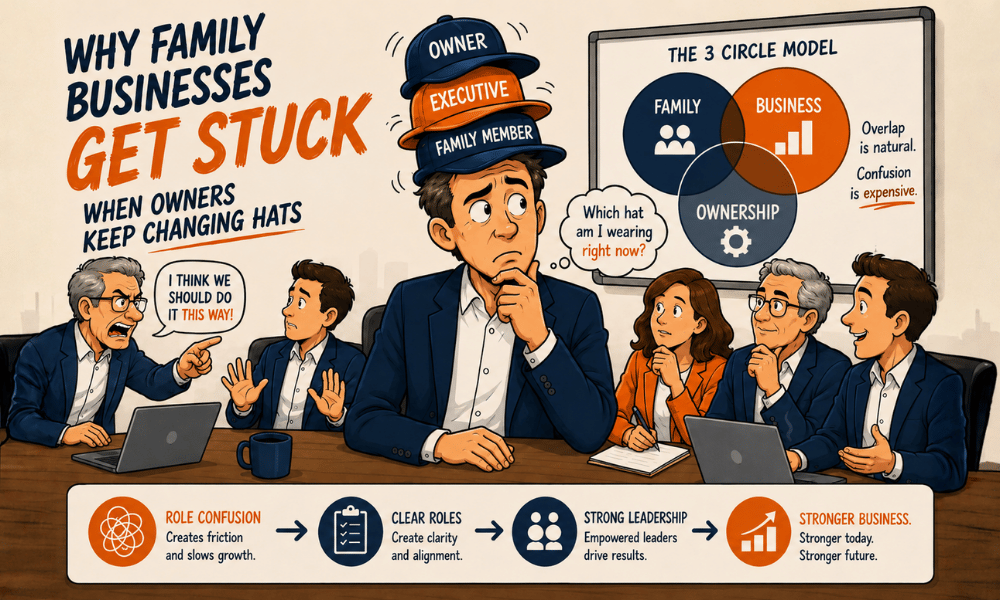
Family businesses rarely get stuck because people do not care.
They get stuck because people care deeply, hold multiple roles, carry long histories with one another, & often move between those roles without noticing the impact.
One moment someone is speaking as an owner. The next, they are acting like an executive. A minute later, they are responding as a parent, sibling, spouse or next-generation family member. The conversation may look like a business discussion on the surface, but underneath it is carrying several different agendas at once.
That is where confusion begins.
And over time, that confusion becomes expensive.
It slows decision-making, muddies accountability, weakens leadership authority, creates mixed messages for the broader team, & places avoidable strain on relationships. Many family businesses assume they have a communication problem or a people problem when in fact they have a role problem.
A Common Pattern Looks Like This
The founder hands day-to-day leadership to the next generation or an external CEO, but still drops into operational conversations when something feels off. Team members start waiting for the founder’s view before acting. The new leader has accountability on paper, but not in practice. Nothing looks obviously broken, yet the business becomes slower, more cautious & more political.
That is role confusion at work.
This is exactly why the Harvard 3 Circle Model remains such a powerful lens.
It shows that family enterprise is not a single system. It is the overlap of three distinct but interconnected systems: family, ownership & management. Individuals may sit in one circle, two circles, or all three. That overlap is not dysfunctional in itself. It is simply the nature of family business.
The real challenge is not overlap.
The real challenge is boundary confusion.
When boundaries are weak, family status gets mistaken for business authority. Ownership gets mistaken for operational leadership. Emotional proximity gets mistaken for decision rights. Informal influence begins to outrun formal accountability.
That is where many otherwise capable family businesses begin to lose traction.
An owner starts commenting directly to staff instead of working through leadership. A founder reopens decisions because letting go still feels risky. A family shareholder raises a legitimate concern, but does so in a way that destabilises the management team. A next-generation leader is handed responsibility, but not the authority required to exercise it properly.
None of this needs to be dramatic to be damaging.
In fact, the most damaging forms of role confusion are often subtle. Quiet overrides. Side conversations. Mixed signals. Hesitation. Meetings after the meeting. A pattern of stepping in that gradually teaches leaders they are only trusted until someone more senior gets nervous.
That creates a culture where accountability becomes conditional.
And once accountability becomes conditional, growth becomes harder.
- The family businesses that scale well tend to understand something important: ownership, family & management each have different jobs to do.
- Ownership is about stewardship. It is about long-term direction, major strategic decisions, leadership appointment, capital allocation, continuity, risk & the overall health of the enterprise.
- Management is about execution. It is about turning direction into action, solving problems, leading people, setting priorities, making decisions & delivering results.
Family is about identity, values, relationships, continuity, legacy & often emotional intensity. Family can be a profound strength in business. It can also complicate decision-making if it is allowed to drift unchecked into spaces where business clarity is needed.
Strong family businesses do not pretend these systems are separate in practice. They know the same people may sit in several circles at once. What they do instead is become far more disciplined about naming the role they are speaking from at any given moment.
That discipline matters.
Because one person may be a family member, owner & executive, but they cannot effectively speak from all three roles at once without creating confusion for everyone around them.
This is why a deceptively simple question can be so powerful:
Which Hat Am I Wearing Right Now?
Asked consistently, that question changes the quality of discussion. It slows down reactive behaviour. It surfaces hidden assumptions. It helps people distinguish between a family concern, an ownership matter & a management decision. It reduces the likelihood that emotion or history will quietly hijack execution.
And it creates healthier conditions for leadership.
Leadership teams in family businesses need more than titles. They need real authority, visible trust & clear decision rights. If they are repeatedly bypassed, corrected from the sidelines, or expected to absorb family anxiety without naming it, they cannot lead cleanly. They become cautious, political, or dependent. None of that supports sustainable growth.
The irony is that owner over-involvement usually comes from a good place.
It often comes from deep care, responsibility, pride, protectiveness, or fear. Founders especially may feel the weight of history. Owners may worry the business is drifting. Family members may fear loss of control, loss of values, or loss of connection. These concerns are understandable. But unless they are channelled through the right forums, they bleed into day-to-day operations & weaken the very leadership capacity the business needs.
So what helps?
- Clearer role definition. Family businesses need explicit language around which decisions belong to owners, which belong to leaders, & which conversations belong in the family system rather than the business itself.
- Better forums. Ownership issues need an appropriate space. Family concerns need an appropriate space. Leadership decisions need an appropriate space. When everything gets dumped into the same room, the loudest role usually wins, not the right one.
- Stronger leadership reinforcement. If the business says leaders are accountable, it must also allow them to lead. Not occasionally. Consistently.
- A shared language for role clarity. This is where the 3 Circle Model is so valuable. It gives families a non-defensive way to discuss complexity. Rather than blaming individuals, it allows the business to examine which system is driving the current tension.
That shift is incredibly useful.
It moves the conversation away from personalities & towards structure. Away from emotional reaction & towards thoughtful stewardship. Away from blame & towards maturity.
And maturity is what growing family businesses need most.
Not distance. Not bureaucracy. Not colder relationships.
Maturity.
The maturity to respect roles.
The maturity to separate care from control.
The maturity to let leadership lead.
The maturity to recognise that preserving the future of the business often requires clearer boundaries in the present.
Family businesses do not need to eliminate overlap. That is impossible.
But they do need to handle overlap with much greater awareness.
Because when owners keep changing hats without noticing, the business pays the price.
When roles become clearer, the opposite happens.
Leaders grow stronger. Decisions get cleaner. Owners stay focused on stewardship rather than slipping into operations. Family relationships come under less strain because fewer business disagreements are being driven by unspoken role confusion.
That is not just better governance.
It is better business.
And very often, it is better for the family as well.
Written by Debra Chantry-Taylor, FBA Accredited Family Business Advisor, Certified EOS Implementer & Founder of Business Action.
Business Action is focused on helping Entrepreneurs lead better lives, through creating a better business. We have a small team of accredited family business advisors, EOS Implementers & Leadership coaches, as well as access to a huge range of advisors through our Trusted Partners Network.