

Most leadership teams think they’re solving problems.
They’re not.
They’re discussing them.
They’re circling them.
They’re putting temporary fixes in place.
And then they’re seeing them again next week.
If the same issues keep coming back, it’s not bad luck.
It’s because you’re not solving the real issue.
The Illusion of Problem Solving
On the surface, it can feel like progress is being made.
You’re having meetings.
You’re talking about the right topics.
You’re making decisions.
But if you look closely, the same problems keep resurfacing.
Different wording. Same root cause.
This is where leadership teams get frustrated.
“We’ve already talked about this.”
“Why does this keep happening?”
Because the real issue was never solved.
Why Teams Don’t Get to the Real Issue
Getting to the root cause is uncomfortable.
It requires:
- Asking harder questions
- Challenging assumptions
- Calling out what’s really going on
So instead, teams settle for the obvious answer.
The symptom.
For example:
“Sales are down”
“The team isn’t performing”
“Communication isn’t working”
Those aren’t issues.
They’re outcomes of something deeper.
When teams stop at the surface, they solve the wrong thing.
What Happens When You Only Solve the Symptom
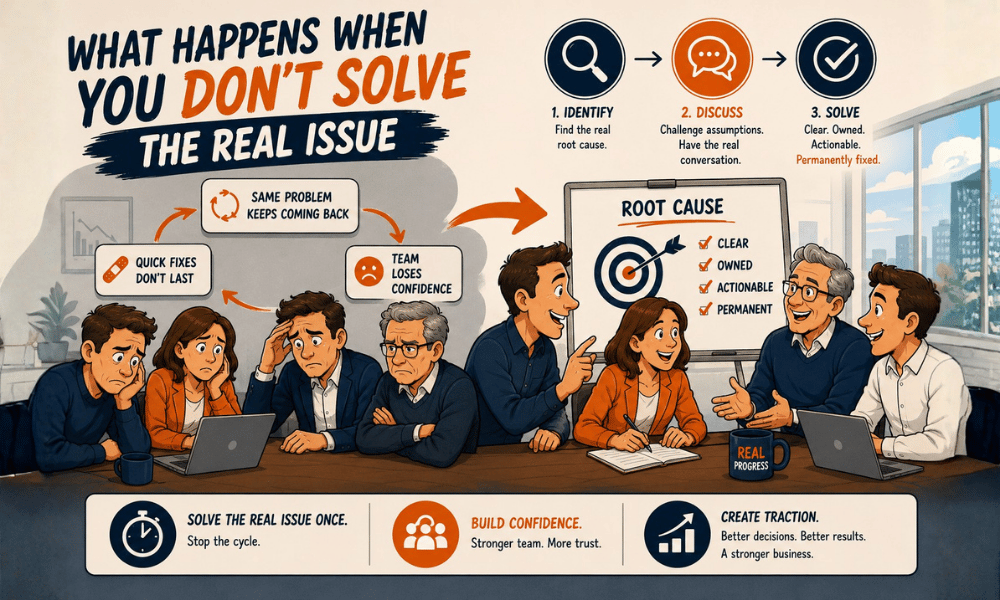
When you don’t solve the real issue, three things happen.
1. The Problem Comes Back
You put a quick fix in place.
It works for a week. Maybe a month.
Then the issue returns.
Because the root cause is still there.
2. The Team Loses Confidence
People start to feel like nothing really gets resolved.
They see the same issues appearing again & again.
Over time, belief in the process drops.
And when belief drops, engagement follows.
3. Leaders Get Pulled Back In
When problems aren’t solved properly, leaders step in.
They fix things directly.
They make more decisions.
They get back into the weeds.
Not because they want to.
Because the system isn’t closing issues properly.
Where EOS Changes the Game
This is exactly what IDS is designed to fix.
Identify. Discuss. Solve.
Simple on paper. Hard in practice.
Identify
This is where most teams fall short.
They identify the obvious issue, not the real one.
Good IDS requires digging deeper.
Asking:
- Why is this happening?
- What’s underneath this?
- What’s the actual root cause?
Until you hit the point where fixing that one thing would stop the issue recurring.
Discuss
This is where honesty matters.
Real discussion means:
Open debate
Different perspectives
Challenging thinking
Not polite agreement.
If everyone agrees too quickly, you probably haven’t found the real issue yet.
Solve
A real solve is permanent.
Not:
“Let’s keep an eye on it”
“We’ll revisit next week”
A real solve is:
- clear
- owned
- actionable
And it closes the issue so it doesn’t come back.
Why Teams Struggle With IDS
Most teams don’t struggle with the tool.
They struggle with the discipline.
They:
- rush the Identify step
- avoid the hard discussion
- settle for partial solutions
Because it feels faster.
But it isn’t.
You either spend time solving the real issue once, or you spend time revisiting it every week.
Family Businesses Feel This More
In family businesses, getting to the real issue can be even harder.
Because sometimes the issue isn’t just operational.
It’s relational.
It might involve:
- unclear roles
- unspoken expectations
- long-standing dynamics
So instead of addressing it directly, teams stay at the surface.
They solve around the issue, not through it.
EOS helps by separating the issue from the person.
It creates a space where problems can be solved without making it personal.
What Leaders Often Get Wrong
Leaders often think they need better solutions.
They don’t.
They need better identification.
If you don’t identify the real issue, even the best solution won’t work.
And the issue will come back.
Clarity at the start saves time at the end.
5 Frequently Asked Questions
1. How do I know if we’re not solving the real issue?
If the same problems keep coming back in different forms, you’re likely solving symptoms, not root causes.
2. What’s the biggest mistake teams make in IDS?
Rushing the Identify step and jumping straight to solutions.
3. How do we get better at identifying the real issue?
By asking deeper questions and not accepting the first answer as the root cause.
4. Why do teams avoid real discussion?
Because it can be uncomfortable and may challenge assumptions or relationships.
5. What does a proper “Solve” look like?
A clear, owned, actionable solution that prevents the issue from recurring.
Final Thought
Most businesses don’t have an issue problem.
They have a problem-solving problem.
When you solve the real issue, things move faster, feel lighter & stop repeating.
That’s where real traction comes from.
Written by Debra Chantry-Taylor, FBA Accredited Family Business Advisor, Certified EOS Implementer & Founder of Business Action.
Business Action is focused on helping Entrepreneurs lead better lives, through creating a better business. We have a small team of accredited family business advisors, EOS Implementers & Leadership coaches, as well as access to a huge range of advisors through our Trusted Partners Network.