

Last week we talked about execution & why the fastest car doesn’t always win.
But here’s where most businesses still get it wrong.
They hear “execution” & immediately think… move faster.
Push harder.
Do more.
Get things done quicker.
That’s exactly how things start to break.
Because real speed doesn’t come from urgency.
It comes from alignment.
And nowhere is that clearer than in a Formula One pit stop.
WHAT FORMULA ONE CAN TEACH ENTREPRENEURS
The Ferrari Pit Stop & Why Great Teams Move Fast Together
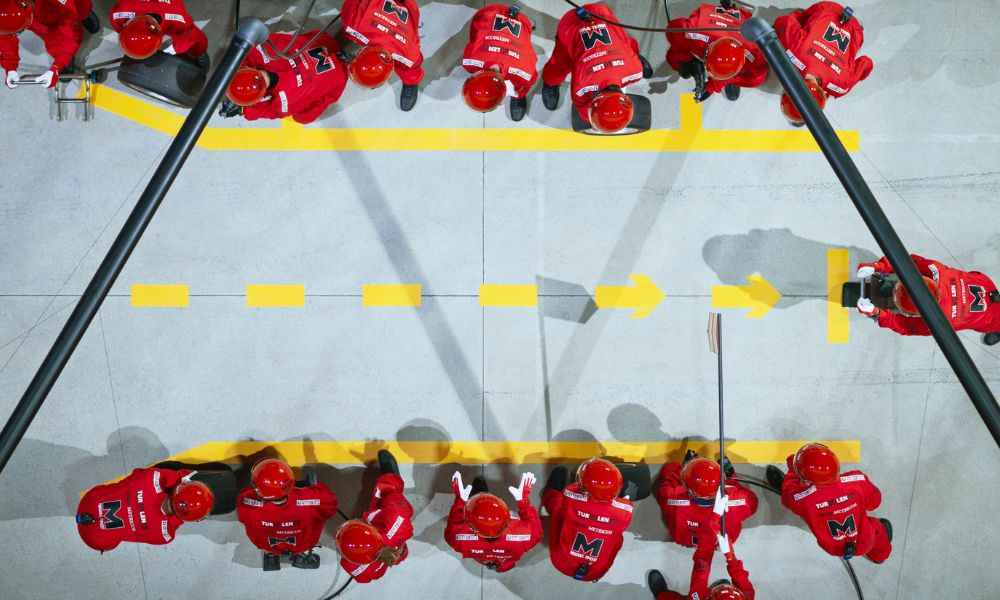
One of the things that fascinates me about Formula One is how something that lasts only a few seconds can determine the outcome of an entire race. If you blink during a pit stop, you will probably miss it. The car dives into the pit lane, the crew swarm around it, tyres are changed & the driver launches back onto the track almost instantly. On television it looks quick. When you see it in person it feels almost impossible.
A modern Formula One pit stop takes roughly two seconds.
In those two seconds more than twenty people perform a perfectly choreographed routine. One group lifts the car, four mechanics remove the tyres, four more attach the new tyres, others stabilise the car & someone monitors the release. Every movement has been practised repeatedly until it becomes instinctive. If even one person hesitates for half a second, the entire stop slows down & the driver can lose valuable track position.
The remarkable part is that this speed does not come from rushing.
It comes from preparation.
Pit crews practise constantly. They rehearse the same movements again & again so that everyone understands exactly what they need to do when the car arrives. Each mechanic has a clearly defined role & trusts the people around them to perform theirs. When the car finally stops in front of the garage, the team does not need to think about what happens next.
They simply execute.
Watching a pit stop closely is like watching a perfectly synchronised dance. No one shouts instructions & no one improvises. The process works because every person understands their role within the system & trusts the rest of the team to do the same.
It is a powerful illustration of how high performing teams operate.
In business, leaders often say they want their organisations to move faster. Teams want quicker decisions, faster implementation & the ability to respond rapidly when opportunities appear. But speed rarely comes from pushing people harder or asking them to work longer hours. Real speed usually comes from clarity.
When people understand their role, know what the priorities are & trust the people around them, work flows naturally.
I have seen many leadership teams struggle because everyone is trying to help with everything. The intention is good, but the result is confusion. Decisions become slower because too many people are involved in the same conversations. Projects stall because responsibilities are unclear. Energy gets wasted on coordination instead of progress.
A Formula One pit stop would collapse instantly if the crew worked that way.
Imagine twenty mechanics all trying to change the same tyre or debating who should release the car. The stop would take minutes rather than seconds & the race would effectively be over. The reason the system works is because every person knows exactly where they fit.
Great businesses often operate in the same way.
When roles are clear & responsibilities are understood, teams begin moving with surprising speed. Meetings become shorter because the right people are in the room. Decisions happen faster because accountability is obvious. Instead of stepping on each other’s toes, people focus on executing their part of the plan.
Watching those Ferrari pit stops in Melbourne reminded me that coordination is often the hidden engine of performance.
From the outside the moment looks effortless. The car stops, tyres are changed & the driver accelerates away. What you do not see are the hundreds of hours of preparation behind that moment. The drills, the practice & the constant refinement that allow the team to perform under pressure.
Businesses are not very different.
The organisations that appear to move smoothly are usually the ones that have invested time in building clear structures & strong communication. People know where they contribute, leaders trust their teams & the entire organisation begins operating with greater confidence.
When that happens, speed becomes a natural outcome.
Not because people are rushing, but because everyone understands how the system works.
Written by Debra Chantry-Taylor, FBA Accredited Family Business Advisor, Certified EOS Implementer & Founder of Business Action.
Business Action is focused on helping Entrepreneurs lead better lives, through creating a better business. We have a small team of accredited family business advisors, EOS Implementers & Leadership coaches, as well as access to a huge range of advisors through our Trusted Partners Network.