
Every business, no matter how successful, eventually hits a point where growth slows, energy dips, & everything starts to feel harder than it should. You work more hours, push your team harder, add more people, buy more tools, sit in more meetings, yet the progress stalls.
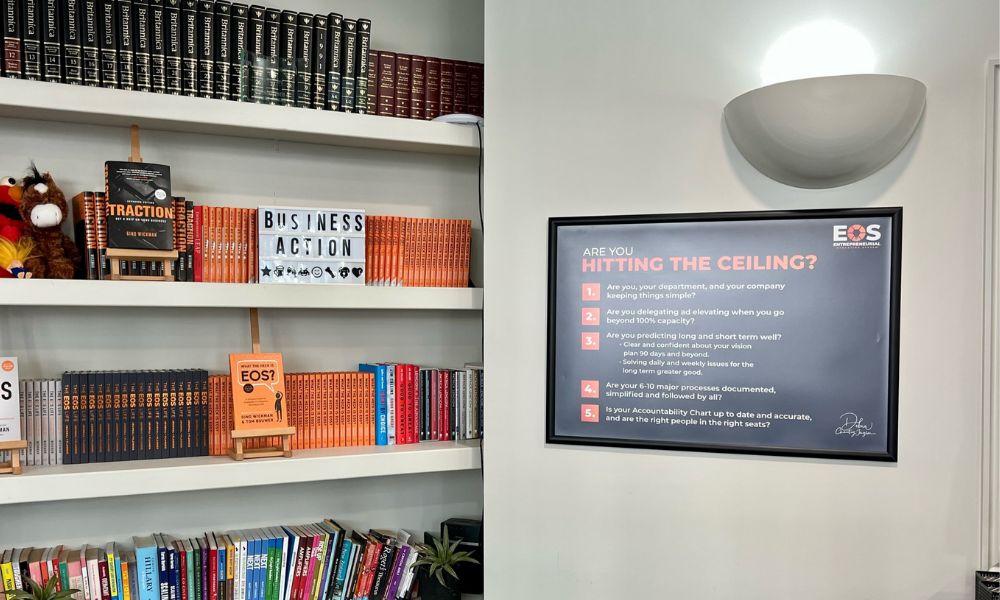
That moment is what EOS calls Hitting the Ceiling.
It’s normal. It’s predictable. It happens at every stage of the journey.
But staying stuck? That part is optional.
This is the EOS playbook for leaders who refuse to stay stuck, leaders who want clarity instead of chaos, progress instead of plateaus, & confidence instead of exhaustion.
Let’s break down what hitting the ceiling really means, why it happens, & the proven EOS tools that help you break through again & again.
What Does Hitting the Ceiling Actually Mean?
Hitting the ceiling is the point where your current way of operating can no longer support the next stage of growth.
It’s not about failure. It’s about outgrowing your old systems, structure, habits, & leadership capacity.
It usually shows up in ways that frustrate even the strongest leaders:
- Growth slows or stops
- Everyone is stretched thin
- Communication breaks down
- Issues keep resurfacing
- Meetings multiply but progress doesn’t
- You feel like you’re dragging the business instead of leading it
- Things that used to be easy now feel heavy
If you’re honest with yourself, you’ll know when you’ve hit it. Your gut tells you before the numbers do.
The good news? EOS gives you a clear path out.
Why Every Business Hits the Ceiling
Businesses don’t hit the ceiling because the leaders are weak. They hit it because the business has grown beyond the capacity of its current structure, systems, or leadership habits. It’s a sign that what got you here will not get you there.
There are five predictable reasons businesses hit the ceiling:
1. Growth has created complexity
More clients, more staff, more moving parts. Complexity creeps in slowly until one day everything feels tangled.
2. You’ve outgrown your structure
Roles blur. People take on too much. Decisions bottleneck.
3. Leadership capacity is stretched
You are no longer leading the business. The business is dragging you.
4. Accountability fades
Too many people, not enough clarity. Everyone is trying their best, yet nothing is truly owned.
5. Old habits are still running a bigger company
You cannot scale a business on the same behaviours that built it.
Hitting the ceiling is the moment you realise the business needs to evolve faster than you have been allowing it to.
The 5 Leadership Abilities: The EOS Method for Breaking Through
EOS teaches five leadership abilities that help you break through every ceiling. Think of them as the master keys that unlock the next level of performance.
When a business applies these abilities with discipline, breakthroughs happen. When they don’t, the ceiling becomes a long-term home.
Here they are, with deeper detail than the usual surface-level explanation.
1. Simplify
Complexity slows you down. Growth creates clutter. Leaders add processes, tasks, meetings, & urgent priorities until the business becomes bloated.
Simplifying is not about cutting corners. It is about eliminating noise.
Simplify by asking:
- What do we stop doing?
- What do we streamline?
- How do we make communication easier?
- What systems are over-engineered?
- What would this look like if it were simple?
Simplifying creates breathing room. It frees your team’s energy. It gives you space to think strategically rather than reactively.
Businesses rarely fail from a lack of ideas. They fail from taking on too many.
2. Delegate & Elevate
This is where most leaders hit the ceiling.
You become the bottleneck because you are stuck doing too much, holding too much, & trusting too little.
Delegate & Elevate demands brutal honesty:
- What do you love & are great at?
- What do you like & are good at?
- What do you not enjoy?
- What do you struggle with?
Your job is to spend most of your time in the top two boxes & delegate everything else. This is not about dumping work. It is about elevating yourself to work at your true level of contribution.
Businesses scale when leaders stop doing everyone else’s job & finally do their own.
3. Predict
Hitting the ceiling feels sudden, but it is not. The signs were there months ago.
Predicting means looking ahead, using:
- Weekly Scorecard data
- Patterns
- Trends
- Your team’s issues
- Your own gut
There are two kinds of prediction:
- Short-term prediction: Weekly Scorecard, rocks, priorities, resource planning.
- Long-term prediction: Looking ahead 6, 12, 24 months & knowing what will break if you don’t evolve.
When you predict well, nothing surprises you. When you don’t, everything becomes a fire.
4. Systemise
A business that depends on memory, heroics, or the “go-to” person will always hit the ceiling. Systemising is how you scale consistently, profitably, & calmly.
It means documenting the handful of core processes that drive 80& of your business:
- How you sell
- How you deliver
- How you onboard
- How you hire
- How you communicate
- How you manage clients
Then, most importantly, getting everyone to follow them. Systemising is not bureaucracy. It is freedom. It removes confusion & creates excellence.
5. Structure
This is the most misunderstood ability & the most essential for breaking through. When you hit the ceiling, it is usually a structure issue, not a people issue. The business needs a new shape.
That’s why EOS uses the Accountability Chart. It forces you to design the structure the business needs, then put the right people into the right seats.
Most businesses try to grow with yesterday’s structure. It never works.
When the structure improves, everything else does too.
Hitting the Ceiling Happens at Every Level
People assume hitting the ceiling is a company-wide event. It isn’t. It happens everywhere:
- Organisational level: The business stops scaling.
- Department level: Marketing stalls. Operations crumbles. Finance can’t keep up.
- Team level: A functional group stops improving & begins to spin.
- Individual level: A leader feels overwhelmed, burnt out, or out of their depth.
The ceiling is always telling you something. Something needs to change. Something needs to evolve. The trick is recognising which level is affected – because each one requires a slightly different response.
A Real-World Example
A founder-led business I worked with had grown quickly. Revenue was strong, demand was high, but internally everything felt like chaos.
The founder was exhausted. He was wearing four hats. Everything had to go through him. Nothing moved unless he pushed it. Classic ceiling.
Once we rebuilt the Accountability Chart, clarified seats, applied Delegate & Elevate, & simplified communication, everything loosened up.
Within three months, fires reduced by half.
Within six months, revenue grew without adding pressure.
Within a year, the founder got his weekends back.
He wasn’t stuck. He was simply trying to run a bigger business with a smaller-business operating system.
How to Break Through the Ceiling
Here is the EOS playbook in its simplest form:
- Name it. Acknowledge you’ve hit the ceiling. Denial prolongs pain.
- Step back. Look at the business from above, not inside the weeds.
- Use the 5 Leadership Abilities. Choose the ability that is most lacking & start there.
- Reset your structure. Rebuild the Accountability Chart based on what the business needs next.
- Solve issues at the root. Use IDS to stop recurring problems for good.
- Tighten the weekly rhythm. Scorecard, Rocks, Level 10 Meetings. Consistency creates breakthroughs.
- Elevate leaders. If individuals have hit their personal ceiling, support them – or restructure their seats.
- Commit to 90 days. Breakthroughs happen when discipline is consistent, not when inspiration strikes.
6 FAQs About Hitting the Ceiling
1. What does hitting the ceiling mean in EOS?
It means the business has reached the limit of its current systems, structure, or leadership capacity.
2. Why does it happen so often?
Because growth naturally creates complexity. Every new stage requires a new way of operating.
3. How do we know we’ve hit it?
When everything feels harder than it should, & results have stalled despite effort.
4. What breaks the ceiling?
The 5 Leadership Abilities: Simplify, Delegate & Elevate, Predict, Systemise, Structure.
5. Can individuals hit the ceiling too?
Yes. Leaders outgrow roles, roles outgrow leaders, & sometimes both happen at once.
6. What’s the most important breakthrough step?
Structure. When you redesign the business around function, not people, everything else becomes easier.
Final Thought
Hitting the ceiling is not a crisis. It is a signal. It tells you the business is ready for its next evolution.
Leaders who refuse to stay stuck do not wait for things to magically improve. They step back, reset, strengthen systems, elevate people, & simplify everything. EOS gives you the playbook. You bring the courage.
📩 Want help figuring out where your business is stuck & how to break through?
Email me at debra@businessaction.com.au & let’s talk.
Written by Debra Chantry-Taylor, FBA Accredited Family Business Advisor, Certified EOS Implementer & Founder of Business Action.
Business Action is focused on helping Entrepreneurs lead better lives, through creating a better business. We have a small team of accredited family business advisors, EOS Implementers & Leadership coaches, as well as access to a huge range of advisors through our Trusted Partners Network.