
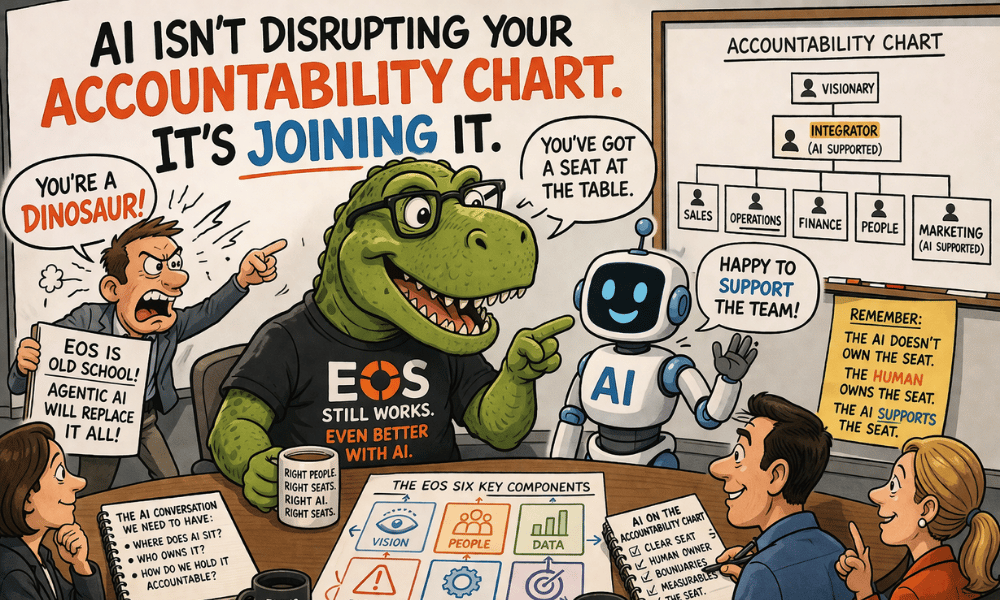
A few weeks ago, someone more or less called me a dinosaur.
Not quite in those exact words, but the message was clear enough.
A gentleman started appearing on my LinkedIn posts telling my audience that EOS was old-fashioned, that agentic AI was coming to replace business operating systems, and that frameworks built around human accountability were about to become obsolete.
I’ll be honest. My first reaction wasn’t especially generous.
But once I had finished muttering at my screen, I did what any good EOS Implementer should do. I took the issue seriously.
I read the paper he sent me. I sat with the uncomfortable questions. I talked it through with leadership teams. I tested it against what I see every day in entrepreneurial businesses. I worked through it with real examples, real client conversations, & my own AI thinking partner.
And eventually I landed somewhere that has genuinely reframed how I now talk about AI and EOS.
AI isn’t disrupting your Accountability Chart.
It’s joining it.
That one sentence has become central to how I think about the future of work inside EOS-run businesses.
Not because AI replaces EOS.
Because AI makes EOS more necessary.
The AI Conversation Most Leadership Teams Are Not Having
There is no shortage of AI noise right now.
Some leaders are panicking. Some are excited. Some are buying tools faster than their teams can understand them. Some are quietly hoping AI will fix problems they have avoided solving for years.
That last one is particularly dangerous.
AI will not magically fix a weak leadership team, an unclear Vision, bad data, messy Processes, unresolved Issues, or a lack of Traction.
In fact, AI tends to amplify what is already there.
If your business is clear, disciplined, accountable, & well-run, AI can create enormous leverage.
If your business is vague, messy, political, or inconsistent, AI can help you create a bigger mess at a much faster speed.
Lovely.
Now the wheels fall off at 300 kilometres an hour.
The real question is not, “Should we use AI?”
Most businesses already are, whether officially or not.
The better question is:
Where does AI sit in our business, who owns it, and how do we hold it accountable inside our EOS structure?
That is the conversation I believe every leadership team needs to have.
AI Runs Through All Six Key Components
AI is often treated as a technology issue.
That is too narrow.
Yes, AI lives inside software.
Yes, there are technical considerations.
Yes, someone needs to care about data security, privacy, integrations, permissions, & governance.
But in an EOS-run business, AI is not just a technology issue.
It touches all Six Key Components.
Vision
How does AI support your long-term Vision?
Does it help you strengthen your core focus, serve your niche better, improve your client experience, or create a meaningful competitive advantage?
Or is your team chasing AI because everyone else is talking about it?
AI should support the Vision, not distract from it.
People
AI changes the work inside seats.
It may remove low-value tasks, increase capacity, change skill requirements, or cause you to redesign roles entirely.
This means AI belongs in the People conversation, not just the technology conversation.
Data
AI is only as useful as the data feeding it.
If your Scorecard is weak, your CRM is messy, your reporting is inconsistent, or your source data is unreliable, AI will not save you.
It may simply help you make poor decisions with more confidence.
A terrifying little gift.
Issues
AI will create new Issues & surface old ones.
Who owns AI decisions? What data can AI access? What must be human-reviewed? What happens if AI gives the wrong answer? How do we protect clients, team members, and the business?
These are Issues to solve, not vague concerns to circle around forever.
Process
This is where many businesses get into trouble.
AI can help document, improve, & automate Processes.
But if the Process is broken, unclear, or not followed by all, AI will only scale the confusion.
Traction
AI only matters if it turns into execution.
That means Rocks, Scorecards, measurables, L10 conversations, clear owners, and follow-through.
Otherwise, AI becomes another exciting idea that appeared in a meeting, created noise, & quietly died in someone’s inbox.
We have enough of those already.
Why AI Belongs on the Accountability Chart
The Accountability Chart is one of the most powerful EOS tools because it removes confusion.
It is not simply an org chart.
An org chart usually shows who reports to whom.
An Accountability Chart shows the right structure for the business, the right seats, the five roles for each seat, & who owns each outcome.
That is exactly the thinking we need for AI.
Because AI is now doing work.
It may be drafting marketing content.
It may be summarising sales calls.
It may be analysing financial trends.
It may be helping write SOPs.
It may be preparing meeting notes.
It may be responding to customer enquiries.
It may be supporting recruitment, onboarding, client service, operations, or leadership decision-making.
If work is being done, we need to know where that work sits.
If AI is supporting a seat, we need to know who owns that seat.
If AI is creating output, we need to know who is accountable for reviewing, approving, using, or rejecting that output.
The AI does not own the seat.
The human owns the seat.
The AI supports the seat.
That is the distinction too many businesses are missing.
AI Belongs in the People Component
This is the part that often surprises people.
Many leadership teams instinctively place AI in technology, operations, software, or systems.
That makes sense at first glance.
But in EOS terms, I believe AI primarily belongs in the People Component.
The People Component is about getting the Right People in the Right Seats.
AI now changes the seat conversation.
It changes what work needs to be done by a human.
It changes what work can be supported by AI.
It changes what capacity means.
It changes the skills required in a seat.
It changes whether someone is spending their time on high-value contribution or low-value repetition.
And in some cases, it may change the seat itself.
This is why I talk about:
Right People. Right Seats. Right AI. Right Seats.
That is not replacing EOS language.
It is extending it to the reality of how work is evolving.
AI Without a Human Owner Is an Accountability Leak
One of the biggest risks I see with AI adoption is not that companies are using it too much.
It is that they are using it vaguely.
Someone signs up for a tool.
A few people start experimenting.
Someone builds a workflow.
Another person plugs AI into a platform.
A team member starts using it to write client emails.
Everyone is impressed.
No one is quite sure who owns it.
That is not innovation.
That is an accountability leak wearing a shiny hat.
EOS-run companies should know better.
If something matters, it needs an owner.
If it is a Rock, someone owns it.
If it is on the Scorecard, someone owns it.
If it is an Issue, someone owns solving it.
If it is a Process, someone owns documenting it, simplifying it, & making sure it is followed by all.
So if AI is creating work, analysing data, communicating with clients, recommending decisions, or triggering actions, someone must own it.
And that someone is not the AI.
It is a human being.
Agentic AI Raises the Stakes
Agentic AI makes this conversation even more important.
Traditional AI tools respond to a prompt. Agentic AI can pursue a goal, plan steps, use tools, retrieve information, trigger workflows, & in some cases take action with a degree of autonomy.
That is powerful.
It is also risky if the business has not defined the seat, boundaries, measurables, escalation points, & human owner.
You would not hire a senior executive, give them vague instructions, no Scorecard, no rules, no boundaries, no budget, & no one to report to.
Well, hopefully you wouldn’t.
So why would we give increasingly capable AI tools less structure than we give a human team member?
The more capable AI becomes, the more EOS discipline it needs.
That means:
- Clear seat
- Clear human owner
- Clear role
- Clear boundaries
- Clear measurables
- Clear review rhythm
- Clear escalation rules
Autonomy without accountability is not innovation.
It is risk in a nice interface.
Use GWC to Evaluate AI Fit
GWC is one of the simplest and most useful lenses for evaluating people in seats.
It can also help leadership teams evaluate whether an AI tool belongs in a particular seat.
Clearly, AI does not “want” something in the human sense. If your AI wakes up passionate about living its best life in your finance department, please unplug it and call someone sensible.
But the framework still works beautifully.
Does the AI Get it?
Does the tool understand enough context, rules, data, tone, process, & constraints to produce useful work?
Does it understand your company language?
Does it produce work that is close to the mark?
Does it reduce effort, or does it create more correction work?
If you are constantly rewriting, retraining, or apologising for it, it may not Get it yet.
Do we Want AI in this seat?
This is the strategic and ethical question.
Do we actually want AI involved in this function?
Does it improve the business, the team, & the client experience?
Does it support our Core Values?
Does it strengthen or weaken trust?
Are we using AI because it genuinely helps, or because we want to look modern?
Not every task should be automated.
Not every client interaction should be AI-assisted.
Not every process deserves a bot.
Some work is valuable precisely because it is human.
Does the AI have Capacity?
Can it do the work reliably, securely, and consistently at the standard required?
Does it have access to the right data?
Are the prompts, workflows, integrations, & guardrails strong enough?
Is there a clear human review point?
Can we measure whether it is working?
Do we know what happens when it gets things wrong?
This is where “Right AI. Right Seat.” becomes very practical.
The wrong AI in the wrong seat creates noise.
The right AI in the right seat creates leverage.
The Most Expensive AI Mistake: Automating a Broken Process
The most expensive AI mistake I see is not choosing the wrong tool.
It is automating a broken process.
AI does not magically make a bad process good.
It makes a bad process faster, louder, cheaper to repeat, & harder to untangle.
Garbage in, garbage out.
Except now the garbage has a subscription plan & an API.
Before you put AI into any Process, slow down & ask:
- What is this core Process meant to achieve?
- Is it documented?
- Is it simplified?
- Is it followed by all?
- Who owns it?
- Where does it currently break?
- What data feeds it?
- What decisions happen inside it?
- Where is human judgement required?
- What would a great outcome look like?
- Should this Process even exist in its current form?
Imagine a business with a messy sales follow-up Process.
Leads come in from multiple places.
No one agrees what qualifies a good lead.
The CRM is patchy.
Sales & marketing blame each other.
Leadership does not trust the data.
Then someone says, “Let’s use AI to automate lead follow-up.”
Fantastic.
Now the AI can follow up with the wrong people, using incomplete information, based on unclear rules, at scale.
That is not transformation.
That is chaos with better formatting.
AI should not be used to avoid fixing the business.
It should be used to amplify what is already clear, healthy, & accountable.
Bring Your People With You
Another danger is treating AI as a top-down mandate.
Leaders get excited, buy tools, announce changes, & forget that the humans in the business are wondering whether they are being replaced.
Here is my strong view:
AI will not take your best people’s jobs.
Bad leadership will.
Most good people do not want to spend their days copying information between systems, writing the same update ten times, or doing admin that drains their soul one spreadsheet at a time.
They would love to remove low-value work.
But they need to understand the plan.
They need to be involved in identifying which work AI should support.
They need clarity on what changes, what does not, & how their contribution becomes more valuable, not less.
This belongs in your People conversations, your L10s, your Issues List, your Quarterly Pulsing, & your Rocks.
Ask your team:
- What repetitive work drains your energy?
- What tasks could AI help with safely?
- Where are we compensating for poor Process with heroic human effort?
- What work would you do more of if AI removed the boring bits?
- What worries you about AI in our business?
- What guardrails would help you trust how we use it?
Do not install AI over the top of your people like cheap carpet.
Bring them into the design.
Practical Exercise: Put One AI Tool on Your Accountability Chart
If you are wondering where to start, do not overcomplicate it.
Pick one AI tool or AI-enabled workflow already being used in your business.
Then answer these questions with your leadership team:
- What is this AI here to do?
- Which seat does it support on the Accountability Chart?
- Who is the human owner?
- Which five roles or outcomes does it support?
- What is it allowed to do?
- What is it not allowed to do?
- What must always be reviewed or approved by a human?
- What data can it access?
- What Scorecard number, Rock, or measurable result will tell us whether it is working?
- What Issues need to be solved before we expand its use?
- When would we pause, change, or switch it off?
That is the beginning of your AI Accountability Chart.
Not a six-month transformation project.
Not a 47-page policy document nobody reads.
Just one tool, one seat, one owner, one set of expectations.
Start there.
Then repeat.
A Simple AI Seat Template
Use this with your leadership team:
AI tool or agent: Name the tool, bot, agent, workflow, or AI-enabled system.
Seat supported: Name the seat on the Accountability Chart.
Human owner: Name the person accountable for the seat and the AI output.
Primary purpose: State what this AI is here to do in one sentence.
Five roles or responsibilities supported: List the specific work it supports.
Boundaries: Define what it can & cannot do.
Human approval required for: List the moments where a human must review or approve.
Data access: Clarify what information it can & cannot access.
Measurable: Choose the Scorecard number, Rock, KPI, or outcome that shows whether it is working.
Review rhythm: Decide whether it is reviewed weekly, monthly, quarterly, or during L10s.
Kill switch: Define when you pause, redesign, or remove it.
This may sound simple.
Good.
Simple gets used.
Complicated gets admired, ignored, & eventually buried in a folder called “AI Strategy Final FINAL v7”.
The Future Is AI Inside Human Accountability
After sitting with the challenge that EOS and human accountability might become obsolete in an AI world, I have landed in the opposite place.
AI does not make accountability obsolete.
AI makes accountability non-negotiable.
The companies best placed to use AI well will not be the ones chasing every shiny new tool.
They will be the ones strong in the Six Key Components.
They will have a clear Vision.
They will have the Right People in the Right Seats.
They will use Data to see what is really happening.
They will solve Issues honestly.
They will document and follow their core Processes.
They will use Rocks, Scorecards, L10s, & Quarterly discipline to create real Traction.
AI can help us think faster, draft faster, analyse faster, summarise faster, & execute faster.
But speed is not the same as wisdom.
And automation is not the same as accountability.
If AI is going to do meaningful work inside your business, it needs to sit somewhere clear.
It needs boundaries.
It needs measures.
It needs a human owner.
The future is not AI versus EOS.
The future is AI inside EOS.
Right AI. Right Seat.
And if believing that makes me a dinosaur, I will take it.
A well-run dinosaur, obviously.
Written by Debra Chantry-Taylor, FBA Accredited Family Business Advisor, Certified EOS Implementer & Founder of Business Action.
Business Action is focused on helping Entrepreneurs lead better lives, through creating a better business. We have a small team of accredited family business advisors, EOS Implementers & Leadership coaches, as well as access to a huge range of advisors through our Trusted Partners Network.