

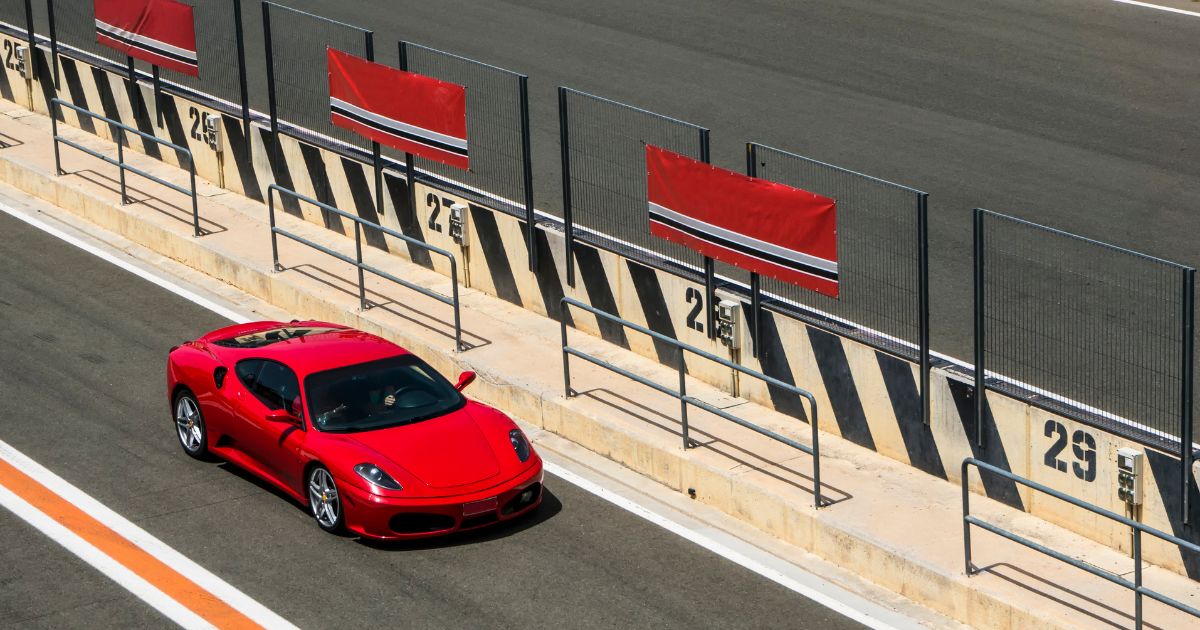
I finally ticked something off my bucket list recently.
I went to the Melbourne Grand Prix.
The atmosphere was incredible. Tens of thousands of people, the noise of the engines echoing around Albert Park, the anticipation before the lights go out. If you love cars even slightly, it’s hard not to get swept up in it.
I’ve loved cars for as long as I can remember. When I was growing up, my dad used to travel to European motor shows & he would bring back photographs and little model cars.
My brother got the Porsches.
I got the Ferraris.
I still have some of those models today, which probably explains why I walked away from the Grand Prix wearing a Ferrari cap & supporting the red team.
Sadly, Ferrari didn’t win the race, although they still managed to get a car on the podium. And Lewis Hamilton – now driving for Ferrari – finished fourth.
Watching the race got me thinking about how much Formula One & business have in common.
Both operate in environments where performance matters. Decisions are made under pressure. Teams have to work together flawlessly.
So, over the next few Sundays I’m sharing a short series called:
Lessons from the Fast Lane – What Formula One Can Teach Entrepreneurs
Let’s start with one of the most fascinating characters the sport has ever seen.
WHAT FORMULA ONE CAN TEACH ENTREPRENEURS
Niki Lauda & the Difference Between Talent and Systems
One of the unexpected side effects of going to the Melbourne Grand Prix recently is that it has sent me down a proper Formula One rabbit hole. The race itself was fantastic, but what really stayed with me afterwards were the stories behind the sport. When you start reading about the drivers, the teams & the history, you quickly realise that Formula One is not just about speed. It is about systems, preparation & thousands of tiny decisions that determine whether a car finishes first or disappears quietly into the midfield. Sitting there watching the cars flash past, I found myself thinking about one driver in particular who understood this better than most.
Niki Lauda.
If you look at photographs of Lauda from the 1970s, he does not immediately look like the stereotypical racing hero. He was not flamboyant & he was not interested in the drama that surrounded the sport. In fact, some people at the time described him as almost clinical in the way he approached racing. What fascinated Lauda was not the thrill of driving fast. What fascinated him was understanding exactly how the car worked & how it could be improved.
When Lauda joined Ferrari in the mid 1970s, the team was not the dominant force people associate with the brand today. Ferrari had incredible engineering talent & a proud racing history, but the organisation lacked the consistency required to win championships regularly. The cars were often fast, yet results were unpredictable. Sometimes the team would perform brilliantly, & other times small technical problems or strategic mistakes would ruin the race.
Lauda approached the situation differently from many drivers.
Rather than simply pushing the car as hard as possible, he began working closely with Ferrari’s engineers to analyse how the entire machine performed. He would spend hours discussing technical details with the team, explaining exactly how the car behaved in different corners & under different conditions. His feedback was precise & methodical, which allowed engineers to refine the car in ways that had not been possible before.
In other words, Lauda did not just drive the car.
He helped improve the system around it.
Over time those improvements started to show results. Ferrari became more consistent, the car became more reliable & the team began operating with greater discipline. The outcome was extraordinary. In 1975 Niki Lauda won the Formula One World Championship with Ferrari, bringing the title back to the team for the first time in over a decade.
Watching the story unfold now, it is tempting to assume that success came purely from Lauda’s talent as a driver. He was certainly talented, but the more interesting part of the story is how much attention he gave to improving the structure around him. Lauda understood that talent alone rarely produces consistent results. Even the best driver in the world cannot win if the car is unreliable, the strategy is flawed or the team is disorganised.
That insight is something many entrepreneurs eventually discover as their businesses grow.
In the early days of a company, progress often depends heavily on the founder’s energy & ability. The leader pushes hard, solves problems quickly & personally drives many of the decisions that move the business forward. This approach works well for a while because the organisation is small & the founder is close to everything that happens.
But as the company grows, the situation changes.
More people join the organisation, decisions become interconnected & complexity increases. What once worked through sheer effort becomes harder to sustain. Leaders often feel as though they are pushing harder & harder just to keep things moving.
This is the moment when the difference between talent & systems becomes obvious.
Businesses that rely entirely on the talent & effort of one person eventually reach a ceiling. No matter how capable the leader is, there are limits to how much one individual can control. Companies that continue growing tend to make a shift similar to the one Niki Lauda helped create at Ferrari. Instead of focusing purely on individual performance, they begin strengthening the systems that support the entire organisation.
Clear priorities emerge. Roles become better defined. Communication improves & decisions start flowing more smoothly through the team. When those systems begin functioning properly, something interesting happens. The business starts performing more consistently even when the founder is not personally involved in every detail.
Formula One offers a powerful illustration of this principle.
The driver may receive the trophy on the podium, but the result is produced by hundreds of people working together behind the scenes. Engineers design the car, mechanics execute lightning-fast pit stops & strategists analyse data to determine the best approach for each race. When those systems work well, the driver has the platform needed to perform at the highest level.
Businesses operate in much the same way.
Talent matters, of course. Visionary founders & capable leaders play an essential role in building great companies. But long-term success usually depends on something deeper than individual brilliance. It depends on building an organisation where the systems support the performance of the people inside it.
Niki Lauda understood this instinctively.
He was certainly a brilliant driver, but what made him exceptional was the way he approached racing as a system that could always be improved. That mindset helped Ferrari become more disciplined, more consistent & ultimately more successful.
For entrepreneurs, the lesson is surprisingly practical.
Sometimes the most powerful way to improve performance is not by pushing the car harder.
It is by improving the machine.
Written by Debra Chantry-Taylor, FBA Accredited Family Business Advisor, Certified EOS Implementer & Founder of Business Action.
Business Action is focused on helping Entrepreneurs lead better lives, through creating a better business. We have a small team of accredited family business advisors, EOS Implementers & Leadership coaches, as well as access to a huge range of advisors through our Trusted Partners Network.