

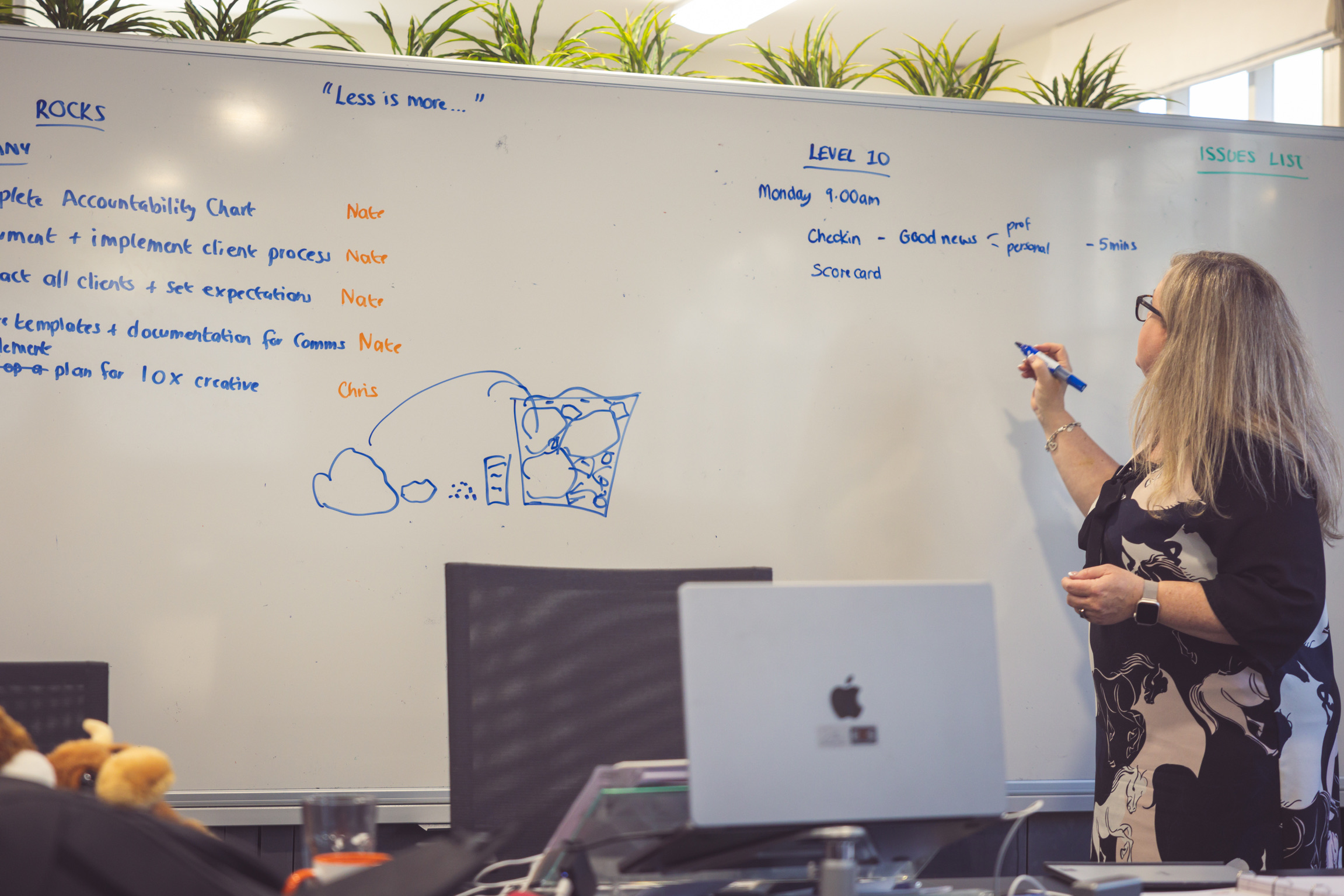
I once sat in on a Level 10 Meeting that told me everything I needed to know about that company’s culture.
The Scorecard? Mostly red.
Rocks? Off track.
To-do’s? Missed for the second week in a row.
But what shocked me wasn’t the data. It was the silence.
No questions. No accountability. Just a quiet acceptance – as if this was business as usual.
The team read through the list, nodded politely, then moved to the next agenda item.
That moment stuck with me.
Because it wasn’t a lack of effort or intelligence that was holding them back – it was tolerance.
And tolerance, left unchecked, kills accountability.
When “Off-Track” Becomes Business as Usual
This isn’t an isolated case.
I see it often – leadership teams who’ve been running EOS for a while, but somewhere along the line, their Level 10s have lost their power.
The structure’s still there – the agenda, the rhythm, the slides – but the purpose has gone missing.
The Scorecard has become just another report.
Rocks are a formality, not a focus.
To-do’s feel optional.
In short: the meeting is happening, but the traction is not.
And here’s the uncomfortable truth:
If you let off-track measurables slide, you’re saying it’s okay to miss the numbers that drive your business.
If a Rock is off track & no one drops it down for discussion, you’re signalling that priorities are negotiable.
If last week’s to-do’s are incomplete & no one asks why, you’re teaching your team that follow-through doesn’t really matter.
That’s not leadership.
That’s tolerance disguised as patience.
And while it might seem harmless in the short term, it’s quietly eroding your team’s performance, energy, & trust.
The True Purpose of a Level 10 Meeting™
A Level 10 Meeting isn’t about going through the motions or ticking boxes.
It’s about using real-time data and team discipline to make decisions that move your business forward – week after week.
Done right, Level 10s:
- Create focus and alignment across the leadership team
- Build a culture of accountability and ownership
- Surface issues early – before they become fires
- Reinforce the company’s vision and priorities
They’re designed to be the heartbeat of your business rhythm.
Every 90-minute session should leave the team sharper, clearer, & more energised than before.
But when they lose that energy – when people stop caring about what’s off track – the heartbeat slows. The business drifts.
The Hidden Danger of Normalising “Off-Track”
When something stays red week after week without discussion, it sends a message – even if you don’t say it out loud.
It tells your team that missing targets is acceptable.
It tells them that accountability is flexible.
And it slowly changes the standard from “we hit what we commit to” to “we’ll get there eventually.”
That shift doesn’t happen overnight.
It’s gradual. Subtle.
And by the time you notice it, the damage is already done.
You’ll start to see:
- Metrics that drift without consequence
- Projects that stall quietly in the background
- Team members who stop owning outcomes
- Meetings that feel heavy instead of productive
Culture isn’t built in a workshop. It’s built in the habits your team repeats – especially in your Level 10s.
When you make red acceptable, you build a culture of tolerance.
When you make red important, you build a culture of accountability.
The Teams That Get Real Traction Treat “Red” Differently
The best EOS-run companies I’ve worked with all share one simple behaviour. They make a big deal out of red.
Not because they want to assign blame – but because they care about improvement.
They understand that red isn’t failure.
It’s information.
When something is off track, it’s not the end of the world – it’s a signal. A clue that something deeper needs fixing.
And instead of brushing it off, they do three things:
- Acknowledge it. If a metric or Rock is off, they call it out immediately – no hesitation.
- Drop it down to the Issues List. They don’t waste time debating or defending. They move it to where it can be solved.
- IDS it (Identify, Discuss, Solve). They dig into the root cause. They make a decision. And they walk away with a real action item to fix it.
No exceptions. No excuses.
That’s how you build traction.
Not through perfection – but through relentless consistency.
Why Accountability Slips (and How to Stop It)
Accountability doesn’t disappear in one big moment – it fades through a thousand small allowances.
A skipped to-do here.
A forgotten Rock there.
A Scorecard item no one’s quite sure about.
The antidote isn’t harshness – it’s clarity.
Here’s what I tell teams when I see this pattern:
- Revisit your standards. What does “done” really mean? What’s acceptable? What’s not? Be specific.
- Review your Scorecard. Are you tracking the right measurables – the ones that actually predict results? If not, simplify.
- Own your Rocks. Every Rock should have one clear owner – not a committee. Shared responsibility is no responsibility.
- Reset your meetings. If your Level 10s have lost energy, stop & reset. Revisit the purpose. Refocus the agenda. Reinforce expectations.
And most importantly – lead by example.
When leadership draws the line, the rest of the organisation follows.
So, we started with one rule: Every “off-track” gets dropped down. Every time.
At first, it felt awkward. Conversations got uncomfortable.
But within a few weeks, something shifted.
The team stopped hiding behind excuses.
They started solving problems faster.
The red on the Scorecard began turning green – not because they were gaming the numbers, but because they were finally addressing the root causes.
Six months later, the same team that had once tolerated mediocrity was celebrating the best quarter in company history.
That’s what happens when you make accountability non-negotiable.
How to Bring the Edge Back to Your Level 10s
If your meetings have become routine, it’s time to reignite their purpose.
- Start on time. End on time. Discipline breeds respect. When meetings run on schedule, everyone takes them seriously.
- Call out red – immediately. Don’t gloss over it. Don’t minimise it. Treat it as the opportunity it is.
- Solve, don’t discuss. The goal of IDS isn’t to talk – it’s to decide. If you’re not leaving with an action item, you’re just venting.
- Track to-dos religiously. To-do’s build momentum. When 90%+ are done each week, everything else improves.
- Review Rocks weekly. Accountability isn’t quarterly – it’s ongoing. Check progress every week so nothing drifts.
- Celebrate wins. Accountability isn’t just about correction – it’s also about recognition. End each meeting by acknowledging what’s working.
Final Thought
A great Level 10 Meeting™ doesn’t happen by accident.
It happens by intention.
If your Scorecard is red, your Rocks are stalling, & your team has stopped caring – you don’t need a new system. You just need to start using the one you have properly.
Because EOS works. But only if you do.
So, ask yourself: Are your Level 10s a box-ticking exercise?
Or are they a 90-minute powerhouse of accountability, clarity, & progress?
The difference between the two could be the difference between spinning your wheels & gaining real traction.
If your Level 10s have lost their edge, let’s talk about getting it back – with structure, discipline, and energy that drives results every week.
Email me at debra@businessaction.com.au or book a free clarity call.
Written by Debra Chantry-Taylor, FBA Accredited Family Business Advisor, Certified EOS Implementer & Founder of Business Action.
Business Action is focused on helping Entrepreneurs lead better lives, through creating a better business. We have a small team of accredited family business advisors, EOS Implementers & Leadership coaches, as well as access to a huge range of advisors through our Trusted Partners Network.